
In comparative politics, we are always looking for methods and tools through which we can make useful comparisons between different states.
With that in mind, understanding political economy is vital in comparative politics because it reveals how the interplay between political institutions, economic systems, environment and technology shapes power, resource distribution, and societal outcomes across different countries.
But how do we systematically dissect these dynamics across different systems?
The diagram below illustrates a series of ten different but inter-related structural features of political-economic systems. All political-economic systems have these structural features in one way or another, illuminating the interconnections between governance, ideology, and economic activity, revealing the deeply political nature of economic processes. How each system performs these functions is what distinguishes them.
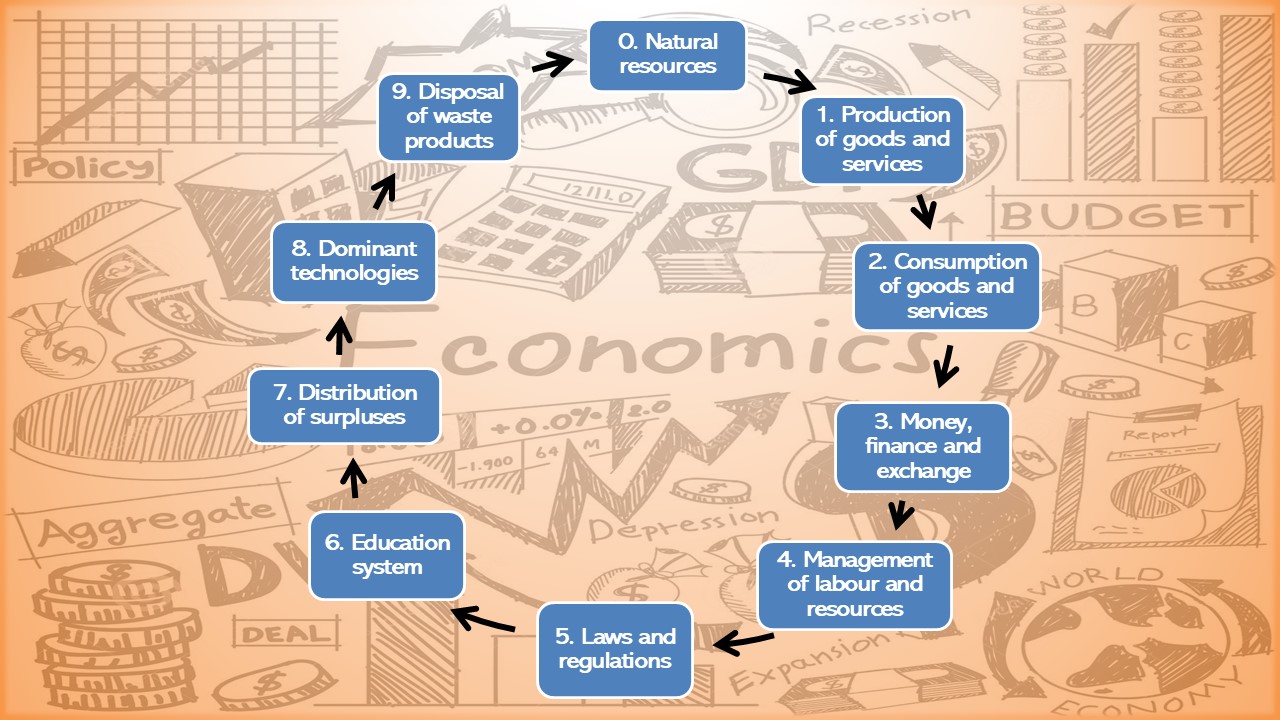
The ten structural features of political-economic systems
1. Natural Resources: The foundational materials and assets provided by the environment, such as minerals, water, and forests, which are harnessed for economic development and societal needs. Key Questions: How do theories conceptualise resource ownership and management? Is nature commodified or protected as a commons?
2. Production of Goods and Services: The processes and mechanisms through which societies create value by transforming resources into usable outputs, including industrial, agricultural, and service-based activities. Key Questions: Who controls production, and what motivates it (profit, welfare, sustainability)?
3. Consumption of Goods and Services: The patterns and practices by which individuals and groups utilise products and services to satisfy needs, desires, and sustain livelihoods. Key Questions: How is consumption patterned, and who benefits most?
4. Money, Finance, and Exchange: The systems of currency, credit, trade, and investment that enable economic interactions, facilitate transactions, and mobilise resources across different sectors. Key Questions: What role do financial systems play in economic stability or inequality?
5. Management of Labour and Resources: The policies and institutions governing the allocation, organisation, and utilisation of human and material resources within a society. Key Questions: How are labour and resources organised? What is the role of power in their allocation?
6. Laws and Regulations: The legal frameworks and policies established to oversee economic activities, enforce standards, and resolve conflicts, which define the boundaries of market and non-market interactions. Key Questions: How are markets regulated, and what role does the state play?
7. Education Systems: The structures and institutions responsible for imparting knowledge, skills, and cultural values, shaping the workforce and influencing long-term economic and social development. Key Questions: How do education systems contribute to economic development and societal equity?
8. Distribution of Surpluses: The methods and systems by which excess economic output is allocated, whether through private accumulation, public redistribution, or other mechanisms, determining societal equity and access. Key Questions: How are surpluses generated and distributed? Who gains and who loses?
9. Dominant Technologies: The prevailing tools, systems, and innovations that drive productivity, influence economic structures, and alter societal interactions. Key Questions: How do technologies shape economic systems and societal interactions
10. Disposal of Wastes: The strategies and systems for managing by-products of production and consumption, addressing environmental impacts and sustainability challenges. Key Questions: How are environmental externalities addressed?

Using the ten structural features of political-economic systems as a heuristic framework allows for a structured comparison of various theories of political economy by providing a consistent set of dimensions to evaluate and contrast their assumptions, priorities, and policy implications. This systematic approach highlights the distinct ways each theory interprets, prioritises, and seeks to address the features, making their strengths, weaknesses, and ideologies clearer.
By representing political-economic systems in this way, we can see how economics is both a deeply political and ideological process (hence the term “political economy”), and how natural resources, the environment, and technology also play an important role.
This approach not only facilitates a deeper understanding of individual theories but also allows for cross-theoretical critiques, fostering integrative perspectives on political-economic systems.
 Edge Dwellers Café
You must be logged in to post a comment.