
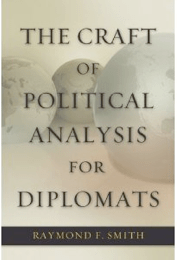
This is the advice that I wish I’d come across at the start of my journey into International Relations as an undergrad. Raymond F. Smith’s seminal 2011 book, The Craft of Political Analysis for Diplomats, offers invaluable guidance for aspiring diplomats and students of International Relations, delineating the skills required for impactful careers in the diplomatic corps.
By examining key insights from Smith’s book, this article explores practical methods to help IR students develop these skills, ensuring that the next generation of diplomats can navigate the intricate landscapes of international politics with precision and purpose.
A quick shout-out here to Jeffrey Robertson for this book recommendation, from his advice To Young North Korea Watchers on his excellent Substack page Diplomatic Seoul. Also, a shout-out to all of my former students who are now working as IR professionals in foreign affairs, government and defence; you are the other inspiration for this article.
Diplomatic analysis as a craft
At the core of diplomatic practice lies the ability to craft political analysis, which constitutes a delicate balancing act between science and art. This balance is inescapable due to the power dynamics and authority relationships within and between governments. As Smith (2011, p. 3) observes,
The diplomat works with a specific primary objective in mind: to protect and promote his country’s interests … The diplomat’s job is to promote his country’s interests, not those of all mankind.
This underscores the dual responsibility of a diplomat to act as both an advocate for their nation and an analyst of broader geopolitical realities.
To cultivate these skills, students must immerse themselves in foundational coursework, including political theory, international law, and conflict analysis. Debate clubs and Model United Nations (MUN) simulations provide opportunities to practice real-world application of these theories, encouraging a synthesis of methodical reasoning and innovative solutions. Students can also sharpen their decision-making skills through participating in crisis simulation workshops that model scenarios requiring the reconciliation of national interests with global responsibilities.
Multifaceted objectives: Inform, explain, influence
Diplomatic reporting is not a monolith but a multifaceted process with distinct aims: informing audiences with accurate data, explaining events with nuanced context, and influencing decisions through strategic insights. As Smith (2011, pp. 7-8) notes,
The objectives of diplomatic political analysis are to inform, to explain, or to influence … The distinction is simple enough in principle, but it is a distinction worth noting because, as indicated above, of the differences in content. Each of these objectives requires a tailored approach, ensuring reports are aligned with the needs of their recipients, objectives, and audience.
For students, mastering these facets begins with exercises that separate factual reporting from analytical commentary and strategic recommendations. Internships with policy organisations offer firsthand exposure to the mechanics of governmental communication, demonstrating how analysis informs policymaking. Writing mock reports or policy briefs for different audiences—NGOs, academic institutions, or government bodies—helps students adapt tone and content to varying expectations, preparing them to produce actionable and impactful analysis in real-world scenarios.

Audience-centric communication
Understanding and engaging with one’s audience is central to effective diplomacy, underscoring the importance of crafting messages tailored to the recipients. As Smith (2011, p. 5) states,
Mid-level foreign affairs officials read a lot. Most senior officials rely more heavily on oral presentations than on written briefs. The young diplomatic political analyst who aspires to high position and influence will have to master written analysis early in his career and hone oral briefing skills as he begins to climb through the ranks.
Audience analysis is essential to ensure that reports resonate with time-constrained officials while addressing complex issues comprehensively. Students can hone this skill through courses on persuasive communication and workshops on audience-specific writing. Role-playing policy briefings allow students to experiment with framing messages for diverse stakeholders, from technical experts to senior policymakers. Mastering the art of public speaking through study-based oral assessments or through organisations like Toastmasters enables aspiring diplomats to deliver concise, compelling oral presentations, complementing their written analyses.
Navigating competition and collaboration
Diplomacy operates in a crowded space where competition for influence is inevitable. As Smith (2011, p. 25) observes,
There will be those who will say, referring to diplomatic political analysis, “This is not a competition.” Do not believe them. It is a competition of ideas, not necessarily zero-sum, but a competition nonetheless. It is a competition for attention, much more nearly zero-sum, since attention requires time and energy, neither in unlimited supply (p. 25).
While competition drives innovation, collaboration ensures mutual growth. Successful diplomats must navigate this duality by engaging constructively with counterparts in intelligence communities, think tanks, and other governmental bodies.
Students can develop these skills by participating in team projects that simulate negotiation scenarios, allowing them to practice both asserting their ideas and integrating feedback. Policy simulation games offer further opportunities to manage competing priorities in high-pressure environments. Networking with peers and professionals in the field strengthens collaborative capacities, while critically analysing reports from established organisations deepens understanding of strategic perspectives.
Balancing integrity with policy constraints
Diplomatic analysis often exists at the intersection of objective assessment and political necessity. Smith (2011, p. 64) highlights the tension, noting,
A key role that embassy reporting can play is to provide a healthy dose of local reality to challenge Washington-based preconceptions. Such reporting may be incredibly useful, but will it be seen in Washington as an aid to policymakers? Set aside whether it should be so seen. In my experience, only the exceptional policymaker will be as open to views that challenge his own as to those that support it
Students should explore ethics courses to build frameworks for addressing these dilemmas. Memoirs of experienced diplomats provide insights into navigating complex scenarios where political sensitivities clash with analytical integrity. Practical exercises, such as writing reports that include counter-arguments to popular policy positions, help students learn to present balanced analyses while respecting institutional priorities. Keep that in mind next time your IR lecturer sets you a report as an assessment!
Mastery of oral and written communication
The practice of diplomacy is as much about skilful communication as it is about fostering understanding in a world of complexity and competing interests. Effective communication is the bedrock of diplomacy, requiring fluency in both written and oral forms. Smith emphasises what this duality means in practice,
Personal tools are those that the analyst controls. They include linguistic and cultural competence, writing style, and sources and contacts. In principle, the breadth and depth of the analyst’s abilities in each of these areas is limited only by his own talent and energy.
Writing skills can be honed through regular practice in diverse formats, such as essays, policy briefs, and blogs. Oral communication can be improved by participating in any kind of public speaking engagement, which teach the nuances of delivery, tone, and audience engagement. Alternating between preparing detailed reports and presenting them as concise briefings ensures proficiency across written and oral communication modalities. Recording and reviewing these presentations further refines delivery and clarity.
From my personal experience, having to deliver 5-6 lectures a week in my academic role helped me to rapidly improve as a public speaker and oral communicator, despite this not being a natural strength. Learning to communicate in the audio-visual realm, particularly in the era of online meetings and peer-to-peer online collaboration, is also well worth the effort.

Adapting to technological change
The evolving technological landscape presents both challenges and opportunities for diplomacy. Smith (2011, p. 5) critiques the over-reliance on presentation tools like PowerPoint, cautioning that they can overshadow substantive analysis,
Oral briefings that build around a presentation tool such as PowerPoint are widely used. The PowerPoint emphasis on ticks, bullets, and shorthand can change the underlying analysis, as well as its presentation. On the one hand, such tools allow key points to be reinforced visually. On the other, emphasis may be placed on a few eye-catching phrases rather than on the substance of the analysis that accompanies them.
Students should embrace technology while also remaining critical of its application. Proficiency in data visualisation tools like Tableau and Power BI allows for the effective presentation of complex data. Familiarity with cybersecurity and ethical considerations in digital communication is essential to safeguard sensitive information. Engaging with AI tools for real-time analysis and simulation ensures readiness for the demands of modern diplomacy, where digital fluency is increasingly non-negotiable.
Practical Tools for success
Delivering complete, accurate, and timely reports is the hallmark of diplomatic success. Smith (2011, pp. 35-36) asserts,
The ideal diplomatic political dispatch would be complete, accurate, correctly predictive, and timely. The good diplomatic political dispatch recognizes that compromises must be made among these qualities and finds the right balance for the subject matter and circumstances at hand.
Achieving this standard requires both analytical and technical expertise.
Students can benefit from coursework in research methods, which equip them to interpret complex data. Specifically, Smith suggests that case studies offer a window into the practical applications of diplomatic analysis. He argues that students should study seminal cases, like the Cuban Missile Crisis or the collapse of the USSR, to understand the dynamics of high-stakes diplomacy to prepare them to apply similar methodologies in their careers.
On technical expertise, geographic Information Systems (GIS) tools offer an edge in analysing spatial dimensions of political events. Every good IR practitioner is unashamedly a map nerd and even learning basic geospatial intelligence skills on Google Earth is a good start.
Of course, nothing beats overseas travel experience for refining ones skills of nuanced communication and empathy, along with the development of area knowledge, cultural literacy and a comparative lens.
Career development
Diplomacy is a career that demands continuous growth and adaptation. Smith (2011, p. 116) notes,
The professional doing a job puts in as many hours as are required, performs the required duties, regards the work as a way to make a living, and lives for when he is not working. The professional approaching his work as a career puts in as many hours as necessary to get ahead, does what is necessary in order to get noticed, has no policy views of his own, develops skills that enable him to provide superior tactical support for policies others make, and seeks jobs that give him visibility to those who control career advancement. The professional who approaches his work as a vocation puts in as many hours as necessary to do the job the way he thinks it should be done, lets his policy views be known even when they differ from the accepted view, and seeks jobs that he finds personally interesting.
Students should create career roadmaps that emphasise skill-building in negotiation, advocacy, and strategic thinking. Mentorship from experienced diplomats provides invaluable guidance, while seminars and certifications in specialised areas ensure lifelong learning. Engaging with professional organisations like the Australian Institute of International Affairs or Young Australians in International Affairs facilitates networking and keeps students abreast of global trends.
Manifesting your inner diplomat into existence
The path to diplomatic excellence is navigated with a compass forged from analytical precision, ethical judgement, and strategic communication. The Craft of Political Analysis for Diplomats serves as an indispensable guide for students of International Relations, offering insights that illuminate the core elements of impactful diplomatic practice.
By adopting the suggested practices outlined here, students can transform themselves into adept navigators of international politics and contribute to steering their nations through the complexities of the global politics.
 Edge Dwellers Café
You must be logged in to post a comment.