
From 2015-2021 I worked on a participatory-action research project exploring the politics of the global permaculture movement. I interviewed over 60 permaculture practitioners from around the world. This 10-part series summarises the findings from those interviews and caps my contribution to the permaculture movement.

At its core, permaculture is more than just a system of sustainable agriculture through conscious ecological design. It is a worldview rooted in a deep commitment to ethical living, based on a comprehensive ideology that prioritises care for the earth, care for people, and equitable distribution of resources. These ethics serve as the foundation for every action taken by permaculture practitioners, guiding decisions not only about how to design landscapes but also about how to structure communities, economies, and societies.
Permaculture’s principles also reflect a broader ideological commitment, incorporating ecological ethics, social justice, and critiques of capitalism. These ideological foundations reflect a growing dissatisfaction with the dominant socio-economic systems that prioritise short-term profits over long-term sustainability and equity.
In contrast to the extractive practices of industrial agriculture and consumer capitalism, permaculture offers an ethical framework for creating systems that are regenerative and just, focusing on the well-being of both the environment and the communities that depend on it.
However, regardless of its rhetorical commitment to “fair share”, it is not always obvious that the permaculture movement has fully integrated the complexity of these broader ethical commitments into its design system.

The three core ethics of permaculture
Permaculture’s ideology revolves around three core ethics: Earth Care, People Care, and Fair Share. These ethics are not just abstract concepts, they are concrete principles that shape how permaculture practitioners engage with the world.
“Maybe I feel that I don’t do enough within the movement to have a clear view, but from the involvement I do have, I’d say maybe no, or do you mean identity as in – when I hear people introduce the idea, they always bring up earth care, people care, fair share, and that for me, they’re the values driving the movement. Maybe people identify with those” (Interviewee #21b).
Earth Care
The first ethic, Earth Care, emphasises the importance of maintaining and regenerating the natural systems that sustain life. Permaculture practitioners see themselves as stewards of the Earth, with a responsibility to protect ecosystems and promote biodiversity.
“A social movement that emerged around design ideas that are based on ecology; underpinned by ethical principles” (Interviewee #33).
This ethic contrasts sharply with the dominant industrial model, which often views the environment as an external resource to be exploited for economic gain. In permaculture, the health of the land is intrinsically linked to the health of the community. A degraded ecosystem is not just an environmental issue—it is a social and economic issue as well.
People Care
The second ethic, People Care, highlights the need for social equity and justice. Permaculture practitioners believe that sustainable systems must support the well-being of individuals and communities, fostering cooperation and mutual aid. This ethic encourages practitioners to prioritise human needs, from food security to social inclusion, while also recognizing the importance of mental and emotional health.
“Permaculture wants a society that is more cherishing, more caring, more aware, more – well, I mean, we know what it is” (Interviewee #1).
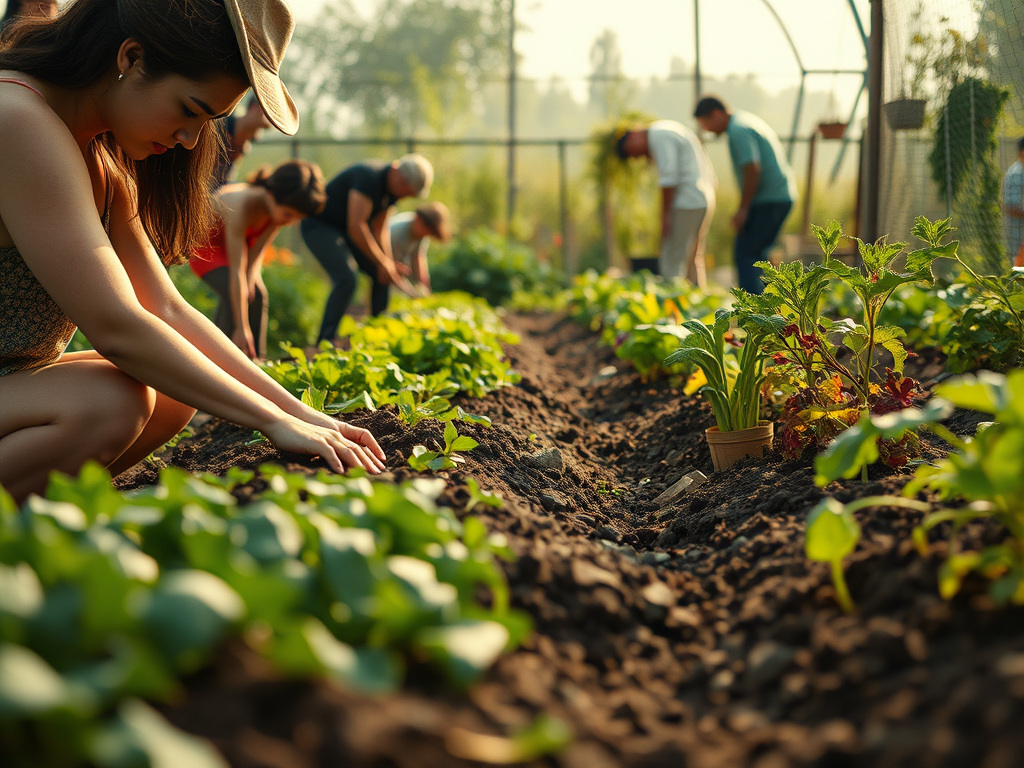
In practice, People Care often translates into community-building activities such as shared gardens, cooperatives, and educational programs. These initiatives aim to strengthen social bonds while providing practical solutions to common challenges, such as access to healthy food and housing.
Fair Share
The third ethic, Fair Share, addresses the issue of equity in the distribution of resources. Permaculture calls for a more just allocation of wealth and resources, advocating for systems that do not hoard wealth or privilege at the expense of others. Instead, resources are shared in a way that ensures everyone’s needs are met while avoiding overconsumption.
“Well, I see it as a – it’s like a node in network that’s being spread naturally, biologically across the planet through people sharing what’s real to them locally, and then spreading that out, or people from other bio regions internationally coming to where there’s hot spots that have been inspired often in Australia, or sometimes it’s in America” (Interviewee #18).
Fair Share encourages a shift away from the capitalist mindset of accumulation and toward a more cooperative, community-oriented approach to resource management. This ethic challenges the economic structures that drive inequality, advocating for systems that redistribute excess wealth and promote collective well-being.
Challenging the status quo
The ideological foundation of permaculture inherently challenges the status quo. By advocating for a system that prioritises ethical behaviour, social equity, and ecological sustainability, permaculture stands in stark contrast to the extractive and exploitative practices that dominate the global economy.
“Well, it’s inherently sticking it to the man in terms of removing the power that corporate interests or the big structures of our society have over us. It takes our energy and redirects it into something much more positive. So that’s not energy which is then feeding that environmentally and socially destructive status quo. Instead that energy is going into forming something more beautiful and more resilient” (Interviewee #16).
In particular, permaculture’s critique of industrial agriculture is sharp. Conventional farming practices often prioritise short-term yields over long-term sustainability, relying on chemical inputs, monoculture, and intensive resource use. These practices degrade the environment, erode soils, and contribute to climate change. In contrast, permaculture promotes regenerative farming practices that restore ecosystems while producing food and other resources.
“That is a big problem but our students are almost very younger generation, and they want to change the Korea, after then its mind also changed. They not followed the materialism. So they want to live on community and farming and making different ways” (Interviewee #5).
“So if you go for BT cotton, you have a whole package of inputs and you have to take a garment on for that, and if your crop is destroyed for whatever reason, or pest-related reasons, or market pricing, then you’ll still have the bottom of the debt, so that’s where politics comes in. In a cold war, I don’t see politics, but if you have to fight a system where there is pressure from the other side of the seed and you want to have your choice of seed, and then politics comes” (Interviewee 9b).
Permaculture’s emphasis on ethics and sustainability offers a powerful critique of the current economic system, which often externalises environmental and social costs. This critique is not just theoretical; it is embodied in the everyday practices of permaculture communities around the world. From local food systems to regenerative farming, permaculture provides tangible alternatives to the extractive logic of capitalism.

Toward justice
Beyond environmental sustainability, permaculture’s ethical framework also has significant implications for social justice. By prioritizing equity and fair resource distribution, permaculture seeks to address some of the systemic inequalities that plague modern society. The ethic of People Care, in particular, calls for the creation of systems that support the most vulnerable members of society, ensuring that everyone has access to the resources they need to thrive.
This focus on justice is particularly important in marginalised or underserved communities. Permaculture projects around the world have demonstrated the power of this approach, from urban gardens in low-income neighbourhoods to food security initiatives in refugee camps.
“As a community activist, I try to integrate permaculture with my feminism, anti-racism, workers’ rights and ‘right to the city’ organizing. I try to be a visible permaculture activist in my community and in the larger permaculture community (online and at international convergences). I actively support the work of decolonizing permaculture and addressing oppressions” (Interviewee #30).
“In saying that it’s inherently political, it’s political because – especially the second ethic of people care means that there needs to be equality, and justice, and opportunities which are not available in our current systems and often not available because of patriarchal systems, or because of inherent racism, or sexism, or various other forms of suppression, as well as political parties openly making use of those for their own gains. So that will put us in opposition with politics. And standing up for that is part of a standing up for political rights rather than having a political alignment” (Interviewee #23).
In many ways, permaculture’s emphasis on localism and community empowerment offers a model for how social justice movements can build more sustainable and equitable systems from the ground up. Rather than relying on top-down reforms, permaculture encourages grassroots initiatives that are tailored to the specific needs and resources of each community.

The challenges of ideological purity
Despite its strengths, permaculture’s commitment to ethical living and ideological purity can also present challenges. The founders of permaculture envisioned a world where communities live in harmony with nature, free from the constraints of industrial capitalism. Bill Mollison’s writings express a deep distrust of industrialised systems, urging a return to local, self-sufficient practices. This vision resonates with many who are disillusioned by the failures of modern capitalism to address environmental degradation.
Yet, while their ideals are noble, they raise critical questions about the feasibility of achieving such radical change. The assumption that collapse is necessary for renewal may unintentionally ignore the realities faced by many communities, especially those already marginalised by existing systems.
While they advocate for ecological sustainability, they can also perpetuate a somewhat romanticised view of nature. The notion that humans can seamlessly integrate with nature may overlook the complexities of our social structures and the power dynamics that influence access to resources.
“We often talk about working with nature, but we forget that human systems can be as disruptive as industrial agriculture. It’s not that simple” (Interviewee #55).
Permaculture’s emphasis on ecocentrism and biomimicry can obscure the complexities of power dynamics and historical injustices in human relations that shape our ecological and social landscapes.
Some critics argue that the movement can be insular, with practitioners adopting an “us versus them” mentality that isolates them from broader environmental and social justice movements. This insularity can limit permaculture’s ability to collaborate with other groups working toward similar goals, reducing its potential impact.
“Probably, one is ego in it and also by wording it permaculture is a good way to marketing but is also alienating other people because of terminology jargons. And you simplify it, you mainstreamed it and then people will be, oh, yeah, okay, it’s all about having respect in nature and observing nature and work with nature and to look after us, to give us food, clothing and housing and arts” (Interviewee #15).
“The point of it was to decide who was in and who wasn’t. And the potential with permaculture to kind of – if it did move to that, if it actually started to say this is our creed, as in you sign up to these 12 principles or you’re out. It’s like, “Ow!” I’m not – I don’t think it will do that but there’ll be a lot of interesting power plays over the next couple of decades, I think, to do with who rises as the great messenger” (Interviewee #22).
Additionally, the movement’s emphasis on localism and self-sufficiency can sometimes lead to accusations of elitism or exclusivity. Permaculture’s reliance on specialised knowledge and training, such as the Permaculture Design Certificate (PDC), can create barriers for those who lack the time or resources to participate.
“In the UK, it’s probably more a middle-class movement with some people trying to support other economic groups to get involved and engage, but for example, here, a lot of those voices are not here because they couldn’t afford to come” (Interviewee #21b).
“Yeah, but it is difficult because if you say permaculture is something for everyone and then you charge a lot for your courses, for example, is that fair? I mean is that fair share? <inaudible. Yeah, that’s the point, how do you get into upper class. I think it’s really complicated with the ethics that we have to get into upper classes or things like that without the others judging you, or saying like, “This is not fair share,” and maybe we have to break some things trying to get where we wanna get but then again it would begin to break our ethics and where are we going” (Interviewee #24b).
This tension between ideological purity and inclusivity is an ongoing debate within the movement. While permaculture’s ethical framework is a powerful tool for creating more sustainable and just systems, it must also be flexible enough to accommodate diverse perspectives and approaches.

The path forward
At its best, permaculture offers a transformative vision for the future—one that is rooted in ethics, equity, and justice. Its commitment to Earth Care, People Care, and Fair Share provides a moral compass for navigating the complex challenges of the 21st century, from climate change to social inequality.
The political and ideological landscape of permaculture is fraught with tension. On one hand, the critique of capitalism offers a framework for addressing systemic failures. On the other hand, the call for disengagement from existing systems raises questions about inclusivity and equity. The challenge lies in reconciling the desire for radical change with the necessity of engaging in the political processes that shape our communities.
In this context, the importance of intersectionality cannot be overstated. An intersectional approach recognises that issues of race, class, and gender intersect with environmental concerns, shaping how different communities experience ecological degradation. By offering practical solutions that are grounded in ethical principles, permaculture has the potential to reshape not only our landscapes but also our societies. As the movement continues to grow, it will be important for permaculture practitioners to remain open to collaboration and innovation, while staying true to their core values.
Annex: Research project outline
This research project is examining permaculture as a transnational social movement, with a view to with a view to exploring how the movement acts at the interface between local-level sustainability transition projects, government policy, civil society, and international politics, across different national contexts, in the contested space of the sustainability transition.
This study employs a qualitative research design based on semi-structured interviews with permaculture practitioners, framed around the five key facilitating conditions that give rise to and shape social movements (Snow and Soule 2010):
- Mobilising grievances
- Contextual conditions
- Movement participation
- Movement dynamics
- Political consequences of the movement
A social movement analysis of permaculture can build on the body of research cited above. Interpreting the permaculture movement through the lens of social movements can facilitate the integration of insights from the existing literature on permaculture politics, to contextualise the individual experiences of permaculture practitioners to be interpreted in relation to the sustainability transition, the global food movement, the political ecology of the environment, and the politics of place, in the process constructing a map of how the permaculture movement operates and impacts at global scale.
Grunewald, P, Habib, B and van der Velden, N. (2020). ‘Collaborative Ecosystem Emergence: Growing coherence and effectiveness in decentralised permaculture networks.’ 12th International Social Innovation Research Conference 2020 (ISIRC). Sheffield, UK. 1-3 September 2020.
Habib, B. (2019). ‘The global permaculture movement as an engine for sustainability transition: A critical appraisal.’ Australian Political Science Association: 2019 Annual Conference. 22-25 September 2019. Flinders University, Adelaide, Australia.
Habib, B. (2018). ‘Permaculture as an International Social Movement‘. 14th Australasian Permaculture Convergence. 15-19 April 2018. Canberra, Australia.
Habib, B. (2017). ‘Permaculture as a Transnational Social Movement‘. 13th International Permaculture Conference and Convergence. 25 November – 2 December. Hyderabad, India.
Interview questions
My semi-structured interviews with participating interviewees were based around the following set of questions:
- Why permaculture, why now? à Why do we need permaculture?
- Someone new to permaculture asks you about the permaculture movement, how would you describe it to them?
- Under what conditions is permaculture likely to have its broadest appeal to new audiences?
- In what ways do you see permaculture as political (in terms of the internal politics of movement and permaculture in the context of local/national/global politics)?
- What’s your view of how permaculture practitioners connect with each other across the movement (PDC’s, convergences, networks)?
- How would you describe the identity of the permaculture movement and its participants?
- What is your evaluation of the diversity of the permaculture movement (in terms of gender, ethnicity, class, indigenous representation, LGBTQIA+ etc)?
- What do you see as appropriate goals for the permaculture movement as a collective, both in your local area and globally?
- What’s your view on how effective permaculture has been in spreading itself to new audiences and locations (PDC, convergences, media etc.)?
- How do you view the ability of permaculture practitioners to engage with government and business organisations?
- What do you see as permaculture movement’s most important innovations as a collective?
- What resources does the permaculture movement need to succeed, and are these available?
- What are the major obstacles facing the permaculture movement?
- Any other thoughts/comments? Any important questions about the permaculture movement that we haven’t covered?
Reference
Snow, D. A., & Soule, S., A. (2010). A Primer on Social Movements. New York and London: Norton and Company.
 Edge Dwellers Café
[…] II. Ideological foundations. […]