
From 2015-2021 I worked on a participatory-action research project exploring the politics of the global permaculture movement. I interviewed over 60 permaculture practitioners from around the world. This 10-part series summarises the findings from those interviews and caps my contribution to the permaculture movement.
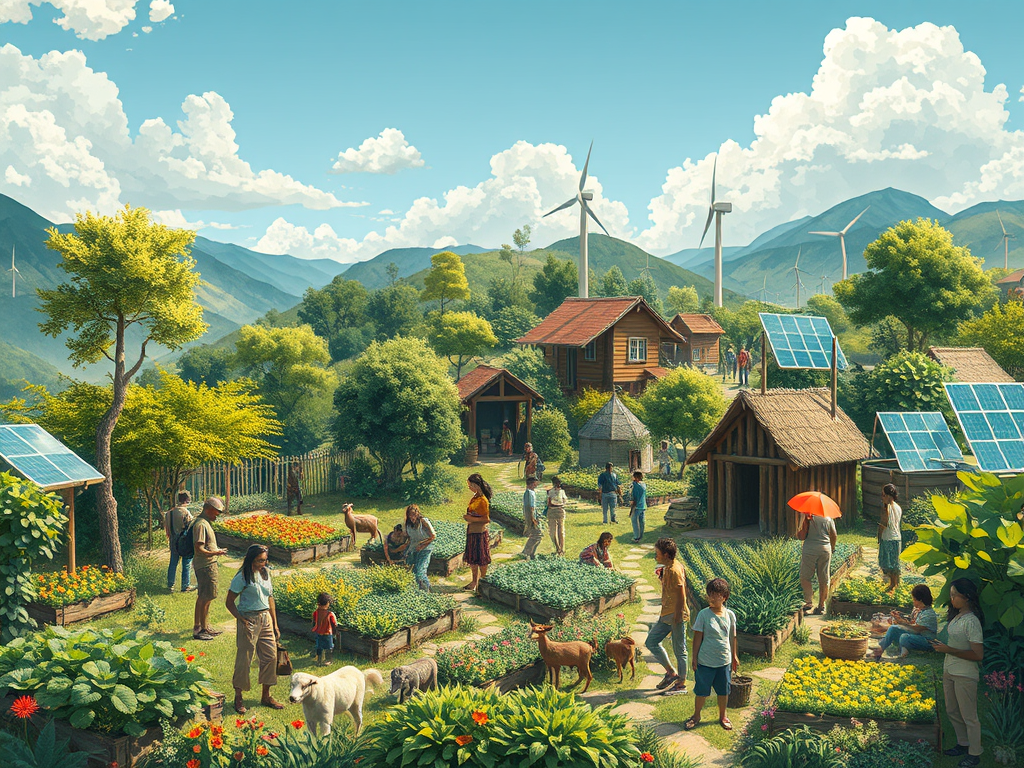
In an age where the future feels increasingly uncertain, the permaculture movement offers a hopeful yet grounded vision for what lies ahead. Rooted in the belief that human systems can be redesigned to work in harmony with nature, permaculture’s long-term goal is the creation of resilient communities that can adapt to, and even thrive within, a rapidly changing world. This future is not just about mitigating the effects of climate change and resource depletion, it’s about reimagining how we live and interact with the Earth and each other.
Permaculture’s teleological perspective—the understanding of its purpose and goals—reveals an ambitious but clear-eyed approach to addressing ecological crisis. The movement seeks to build systems that are not only sustainable but regenerative, fostering ecological health, community resilience, and social equity.
In contrast to more reactive environmental movements, permaculture is proactive, focused on designing a future where humans and nature coexist in a mutually beneficial relationship. However, this vision does have its more apocalyptic interpretations within the movement.
Resilience in the face of crisis
Resilience is at the heart of permaculture’s vision for the future. In a world increasingly shaped by the impacts of climate change, economic instability, and social inequality, the ability to absorb shocks and adapt to new realities has never been more important. Permaculture practitioners argue that the crises we face are not temporary disruptions but indicators of deeper systemic failures. As such, permaculture’s goal is to create systems—both ecological and social—that can withstand and adapt to these challenges.
“I think that permaculture has always been needed. Perhaps we wouldn’t have ended up in the situation we find ourselves today, if there had been more thought and action all along. However, we are where we are: past the point where we can avoid climate change. Then there are things like the loss of biodiversity and so on. Whether or not life/the environment etc has got worse, it would be better for the planet and all life forms in it if everyone were to engage in looking holistically at solutions and taking appropriate action” (Interviewee #31).
“I think for a lot of people that it’s more about their own journey or their own experience rather than the movement, but it can also be really careful to know that you’re part of the movement. And having some of that data, telling that story – telling the story really that there is this global network, there are all these people all around the world who are contributing to this work, who are creating this kind of global resilience. All that’s really a really important story” (Interviewee #47).
Unlike conventional systems that often prioritize short-term gains at the expense of long-term stability, permaculture designs are built with adaptability in mind. For example, permaculture gardens incorporate a wide variety of plant species, ensuring that if one crop fails due to disease or changing climate conditions, others can continue to provide food and maintain ecological balance. This diversity is a key component of resilience, allowing permaculture systems to remain productive even in the face of unexpected challenges.
But permaculture’s vision of resilience extends beyond the natural environment. Social and economic resilience are equally important. By fostering local self-sufficiency and community collaboration, permaculture seeks to build networks of support that can withstand external shocks, whether they come in the form of economic downturns, political upheaval, or natural disasters.
Teleological principles of permaculture design
Looking across the canon of key permaculture texts, from the writing of Bill Mollison and David Holmgren to instructional books from an array of other practitioners from across the anglophone world (see reference list below), there are clear teleological principles underpinning permaculture design. These principles are also communicated clearly, if a little haphazardly, through permaculture design courses (I completed mine in 2014).
Design by nature’s patterns: Inspired by works in pattern theory (Alexander 1977) and biomimicry (Benyus, 1997), this foundation seeks to harmonise human systems with ecological cycles, minimising disruption.
Holistic systems thinking: Permaculture is predicated on understanding the interconnectedness of living systems, borrowing heavily from systems theory (Capra 1996; Bertalanffy 1968) to model agricultural and societal designs that mimic natural processes. This foundation encourages adaptive strategies that are dynamic and resilient in the face of ecological uncertainties.
Resilience through diversity: A cornerstone of permaculture design is the prioritisation of diversity as a mechanism for resilience. This foundation mirrors ecological principles, such as the redundancy hypothesis (Holling 1973), which underscores the importance of multiple, functionally overlapping systems to withstand disturbances. Diversity in plant species, ecosystem roles, and human communities ensures long-term sustainability.
Protracted and thoughtful observation: In line with teleological intentionality, permaculture places a premium on extended observation over impulsive action. This principle draws from landscape ecology (Forman & Godron 1986), emphasising the necessity of understanding environmental patterns and interrelations before intervention.
Self-regulation and feedback loops: Recognising the role of feedback mechanisms aligns permaculture with systems thinking (Bertalanffy 1968). Self-regulating designs rely on internal checks to maintain equilibrium, fostering systems that evolve sustainably without external interference.
Future care and intergenerational equity: Extending beyond immediate needs, this foundation commits to the long-term stewardship of resources for future generations. Drawing from concepts in sustainable development (Brundtland 1987) and intergenerational justice (Barry 1997), this principle reinforces a forward-looking ethical commitment.
Edge effects and marginal gains: The value of edges—transitional zones between ecosystems or systems—is a teleological emphasis that highlights productivity and innovation in marginal areas. This principle aligns with Howard Odum’s ecological studies on ecotones (Odum 1971), which identify edges as zones of heightened interaction and opportunity.
Energy efficiency and renewable cycles: Fundamental to permaculture is the teleological aim of creating systems that maximise energy use while minimising waste. Influenced by principles of energy descent and thermodynamic sustainability put forward by Howard Odum (1971), this foundation integrates the use of renewable resources and circular economies to reduce dependency on finite inputs.
Each of these elements underscores a deeply purpose-driven framework, situating permaculture as both a design science and an ethical philosophy aimed at fostering resilient, equitable, and regenerative systems.

Conscious practice
Interviewees across the board were very clear on the teleological vision underpinning the 12 permaculture design principles as rooted in a purposeful and adaptive approach to creating sustainable systems that harmonise human needs with ecological integrity.
The design principles collectively emphasise intentional observation, resource conservation, and productive outcomes while embedding self-regulating and feedback-driven mechanisms to ensure ongoing evolution and balance. Together, these principles reflect a long-term commitment to fostering interconnected, efficient, and ecologically sound designs that support both human and planetary well-being.
“Describing permaculture itself is not easy. I often just say to people it’s a design system for sustainable human settlements in that enormous breadth and in its tiny intricacies as well. So if we wanna think about being able to sustain our ability to live on this planet, it’s a design system to do that, to make that achievable in all the different ways that we operate” (Interviewee #26).
“Well, it’s remarkable in a way, isn’t it, because it’s more than 30 years since I heard about permaculture. Permaculture offered me a framework then. I was looking around in the ‘80s for some framework for my environmental activism and I think permaculture gave that to me then, and for me, it continues to give me that framework for the wider world” (Interviewee #34)
“It’s about helping people work out how to think through problems, and problem-solve, and try and find solutions to immediate issues like clean water, and food, and food security, and shelter, shade, just really basic stuff like that without them necessarily being dependent on larger organisations for everything that comes their way” (Interviewee #48).
The 12 permaculture design principles can be considered teleological because they are purpose-driven and aim towards achieving specific long-term goals in ecological and social systems. Each principle provides a guideline for actions and designs that inherently aim to fulfil the overarching goals of sustainability, resilience, and regenerative living.
By aligning practical methodologies with ethical intentions, these principles embody a teleological approach to creating systems that contribute to the health of both people and the planet.
A new paradigm for human-nature relationships
Permaculture represents a paradigm shift in how we think about our relationship with the natural world. Traditional approaches to environmental conservation often focus on minimising harm, with the implicit assumption that human activity is inherently destructive. Permaculture, by contrast, envisions humans as a potentially positive force within ecosystems, capable of regenerating damaged landscapes and enhancing biodiversity.
“A lot because early days, especially starting off – because if you really look at – you are asking a wildlifer, so in my training, I was trained to be an misanthrope, right? I’m the spokesperson of the animals and those who cannot speak for themselves or trees. So for them, really, agriculture has been the first violence. The settlement has been the first violence, which is aided by agriculture, so agriculture has been always on the opposite end of conservation, something wild, wilderness, and we somehow, even though people may like wilderness or not, but it is associated with the good thing. There is in a wild, remaining wild is still a good thing, even to people who have never been in wild. So in that way, agriculture is always on the opposite end. Not a good thing but yet we need it, kind of, and a necessary evil. But permaculture is probably the first one which strives to bridge a certain gap. That gap will remain because permaculture will never become a wilderness management, but still to that extent, that it can be as close to the nature as possible. So, as a method, it has first tried to make it possible that it’s not intrusive or it doesn’t have such as large footprint as the other agricultural practices are in that way” (Interviewee #7).
“I’m of the impression that climate change sometimes feels like the comet to the dinosaurs. It’s kind of like – at times, it feels like people – we may not be able to stop it – well, I don’t think we’ll be able to stop it. We’ve come too far, but what we can do is help and support the Earth as needed to help regenerate. And in seven generations’ time, things may be different. Things may be completely not as we planned as well, but you know what, I’d rather be on the – I’d rather have – I don’t call it hope, but it’s like as Joanna Macy says like it’s active hope. It’s not hope as in like, ‘Oh, yeah, I’ll just sit back and hope everything is gonna be okay’.” It’s like, ‘My hope is actually generated from action, from positive action’” (Interviewee #14).
While permaculture practitioners acknowledge the seriousness of the ecological crises we face, they offer a blueprint for a future where human activity is aligned with ecological health and regeneration.
Navigating the apocalyptic narrative
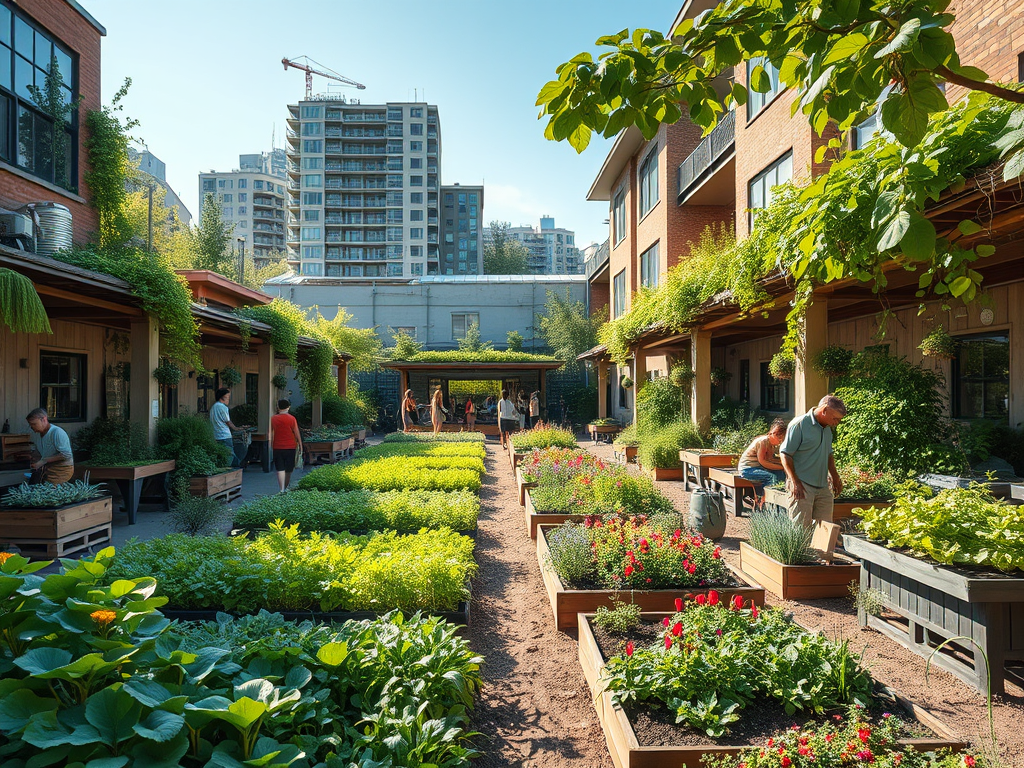
Permaculture’s vision for the future is often framed as a response to global crises, a multifaceted convergence of ecological degradation, resource depletion, and socio-economic inequities, resulting from unsustainable industrial practices and anthropocentric paradigms that are inherently prone to failure. Practitioners interpret these crises through the lens of systemic collapse, wherein the exploitation of finite natural resources, coupled with biodiversity loss and climate instability, undermines the planet’s capacity to sustain life.
Drawing on frameworks such as energy descent (Odum 1971) and ecological overshoot (Catton 1982), permaculture identifies the crisis as a call for transformative action towards regenerative practices. This is the context in which permaculture’s teleological framework prioritising resilience, localisation, and self-sufficiency sits, along with its advocacy for designs that mimic natural ecosystems to restore balance and equitably meet human needs.
“I think they end up gonna say what it is at the moment rather than what it could be but I actually think economic contraction is one of those things that really makes people step on the ego, ‘I really got to do something different’, or, sadly, something cataclysms, some kind of political or economic or environmental – not disaster but something that makes everyone really like oil petrol shortage, where suddenly people would stop in their everyday life. I think that’s what it is. It’s the everyday life thing, not the bigger broader stuff, but something that affects people day to day. That really starts to touch people to go, ‘I have to make a change today because, otherwise, I can’t eat or I can’t get a work and if I can’t get to work, so what I’m gonna do?’” (Interviewee #26).
This framing not only acknowledges the urgency of addressing immediate environmental and social challenges but also underscores the opportunity for cultivating thriving, adaptive communities in the face of inevitable systemic transitions.
Some within the movement view collapse not merely as an inevitable disaster but as an opportunity for transformative regeneration, where old paradigms of extraction and consumerism are replaced by more sustainable, decentralised ways of living. This perspective draws from the work of thinkers like Richard Heinberg (2010), who argues that the collapse of industrial society could catalyse the emergence of new, locally focused, and ecologically integrated communities.
“Yeah, people are looking for – I mean that’s – maybe that’s just the way that it has the power to influence is by becoming really, really strong at the horizontal level and creating individuals and communities that are resilient, so then when the power structures do fall, which is inevitable with the ending of capitalism, which again, who knows when that’s happening. That’s when it will find its feet in those more high level ways, but then again, if it spreads far enough horizontally, surely, at some point, some of those individuals who are interacting with the movement have to eventually get into positions of power surely” (Interviewee #19).
Permaculture practitioners who embrace this view advocate for collapse as a necessary release from the destructive forces of capitalist expansion and ecological overshoot. They suggest that, by intentionally designing resilient, regenerative systems, we can mitigate the impacts of collapse while simultaneously enabling a more just and harmonious relationship with the earth. Permaculture co-founder David Holmgren has even suggested that the collapse could be intentionally hastened by the adoption of voluntary lifestyle simplicity by the global middle class, along permaculture lines (more on this in later articles in this series).
“My argument suggests this could happen by reducing consumption and capital enough to trigger a crash of the fragile global financial system. This provocative idea is intended to increase understanding while taking the risk that the argument could turn people away from permaculture as positive environmentalism, and brand me a lunatic, if not a terrorist. That risk is an analogy for the massive risks that humanity now faces, where all options have unintended consequences and that normal apparently sensible behaviour is just as likely to lead to disaster as the most apparently mad schemes. Even mainstream ‘responsible’ proposals for saving us from climate chaos could also crash the financial system. In times of tumultuous change, small events may trigger big changes we can’t control; a key understanding from the permaculture principle Creatively Use and Respond to Change.” (Holmgren 2014).
This optimistic, even myopic view sees collapse as a fertile ground for the evolution of more equitable, sustainable societies that align with permaculture principles of Earth care, people care, and fair share.
A crisis framing that veers into apocalyptic territory can be a powerful motivator. For a time, I myself was also an adherent of the apocalyptic view. However, it also carries risks. A focus on crisis and collapse can sometimes lead to fatalism, apocalypse and doomerism burnout, or an overly narrow focus on survivalism, potentially alienating those who are not already part of the movement.

This passage from Interviewee #48 is worth quoting at length, because they start from the premise of apocalyptic crisis and weigh up the individualist and collectivist responses to it:
“So, bringing people back to being able to provide for themselves without being part of the industrial machine and the sort of capitalist agro-economy is very, very empowering and very necessary because what does it come back to, like if things get very, very disrupted and very difficult, and law and order start to breakdown, and transport starts to breakdown, and network starts to breakdown, we all know there’s only three days’ worth of food in the supermarket. And then people start rioting and we have all those sorts of issues, but building – really the only way we can look at those problems in a sensible way is to say, “Well, how can we provide for ourselves locally?” ‘cause the people who can go home and have chickens in the backyard and have food available, they’re gonna be a lot more resilient and the people who have networks with other people in the area. It’s very interesting because in these times that are quite apocalyptic, there’s sort of two ways that people are going. There’s people who would towards the prepper phenomenon. Are you guys familiar with that? So, it’s all about isolation. It’s about you’re getting your bunker with your guns and your tin – your canned goods, and your video console to keep yourself amused, and you sort of hunker down and somehow, you’re gonna wait it out. And then the other way, which is very much the permaculture thinking way, is you build community resilience because communities actually survive where individuals don’t survive. And even though – it’s funny ‘cause permaculture and prepping, they kind of have a lot in common in a lot of ways and preppers are really, really useful if you go onto their websites and their Facebook sites. They’ve got all sorts of fantastic tips for how to do stuff, but they’re really sort of – it’s interesting. They’re like an outgrowth of this extreme individualism culture that we’ve had and the fantasy that you could survive it on your own, which you can’t” (Interviewee #48).
While permaculture offers solutions to these crises, it is important for the movement to balance the urgency of the moment with its constructive, forward-looking vision. After all, permaculture at its heart is about building something better in the place of ecologically and socially destructive lifeways.
Building a just and equitable future
In addition to its focus on resilience and sustainability, the permaculture movement is deeply committed to social and economic justice. The ethic of Fair Share challenges the economic inequalities that have been exacerbated by the globalised economy, calling for a more equitable distribution of resources. This commitment to justice is particularly important in the context of climate change, where the most vulnerable communities are often those least responsible for the problem.
“I write about permaculture and social justice, trying to link permaculture to other movements that envision a better world. As a community activist, I try to integrate permaculture with my feminism, anti-racism, workers’ rights and ‘right to the city’ organising. I try to be a visible permaculture activist in my community and in the larger permaculture community (online and at international convergences). I actively support the work of decolonising permaculture and addressing oppressions” (Interviewee #30).
“So it’s the food actually, and if you see the whole history of even colonisation, it’s the spices. So in history, actually politics have moved with our food. So what is not there in politics? Food is politics. So permaculture, as it expands into areas of social justice, areas of accessibility, these are hugely political ideas” (Interviewee #7).
Permaculture’s focus on local solutions is a key part of its approach to justice. By empowering communities to design and manage their own food systems, water supplies, and energy sources, permaculture helps to build resilience from the ground up. This grassroots approach ensures that solutions are tailored to the specific needs and resources of each community, rather than being imposed from the outside.
An ecocentric vision for the future
Permaculture’s teleological perspective offers a hopeful and practical vision for the future. In a world where many are increasingly disillusioned by the failures of industrial systems, permaculture provides a blueprint for how we can build resilient, sustainable, and just communities. Its emphasis on ethics, regeneration, and resilience offers a powerful alternative to the status quo, demonstrating that a better future is not only possible but within our reach.
“I see permaculture as this incredible tool for land regeneration, connecting people back with the land, actually designing spaces which heal the separation between humans and nature as well, like humans are actually designed into nature and it uses smart design to do that, and as well as ecological restoration. So, its capacity to regenerate is endless” (Interviewee #14).
As the movement continues to grow, it will play an increasingly important role in shaping the future of sustainability. By focusing on long-term resilience, ethical design, and community empowerment, permaculture offers a vision of the future that is both hopeful and grounded in the realities of our current challenges. In a world where the future often feels bleak, permaculture provides a path forward—one rooted in the belief that we can, and must, build systems that regenerate the earth and support the well-being of all its inhabitants.
References
Permaculture canon
Bane, P. (2012). The permaculture handbook: Garden farming for town and country. New Society Publishers.
Bell, G. (1992). The permaculture way: Practical steps to create a self-sustaining world. Permanent Publications.
Bell, G. (1995). The permaculture garden. Permanent Publications.
Crawford, M. (2010). Creating a forest garden: Working with nature to grow edible crops. Green Books.
Falk, B. (2013). The resilient farm and homestead: An innovative permaculture and whole systems design approach. Chelsea Green Publishing.
Fern, K. (1997). Plants for a future: Edible and useful plants for a healthier world. Permanent Publications.
Fukuoka, M. (1978). The one-straw revolution. Rodale Press.
Hemenway, T. (2001). Gaia’s garden: A guide to home-scale permaculture. Chelsea Green Publishing.
Hemenway, T. (2009). Gaia’s garden: A guide to home-scale permaculture (2nd ed.). Chelsea Green Publishing.
Hemenway, T. (2015). The permaculture city: Regenerative design for urban, suburban, and town resilience. Chelsea Green Publishing.
Holmgren, D. (2002). Permaculture: Principles and pathways beyond sustainability. Holmgren Design Services.
Holmgren, D. (2009). Future scenarios: How communities can adapt to peak oil and climate change. Chelsea Green Publishing.
Holmgren, D. (2014). Crash on Demand: Welcome to the Brown Tech Future. Holmgren Permaculture Vision and Innovation.
Jacke, D., & Toensmeier, E. (2005). Edible forest gardens: Ecological vision and theory for temperate climate permaculture (Vols. 1–2). Chelsea Green Publishing.
Law, B. (2001). The woodland way: A permaculture approach to sustainable woodland management. Permanent Publications.
Macnamara, L. (2012). People & permaculture: Caring and designing for ourselves, each other, and the planet. Permanent Publications.
Mollison, B. (1979). Permaculture two: Practical design for town and country in permanent agriculture. Tagari Publications.
Mollison, B. (1988). Permaculture: A designer’s manual. Tagari Publications.
Mollison, B., & Holmgren, D. (1978). Permaculture one: A perennial agriculture for human settlements. Tagari Publications.
Mollison, B., & Slay, R. M. (1991). Introduction to permaculture. Tagari Publications.
Mollison, B., & Slay, R. M. (2011). Introduction to permaculture (2nd ed.). Tagari Publications.
Morrow, R. (2000). Earth user’s guide to permaculture. Kangaroo Press.
Shepard, M. (2013). Restoration agriculture: Real-world permaculture for farmers. Acres U.S.A.
Whitefield, P. (1993). Permaculture in a nutshell. Permanent Publications.
Whitefield, P. (2004). The earth care manual. Permanent Publications.
Woodrow, L. (1996). The permaculture home garden. Penguin Books.
Academic literature
Alexander, C., Ishikawa, S., and Silverstein. (1977). A Pattern Language: Towns, Buildings, Construction. Oxford University Press.
Barry, B. (1997). Sustainability and Intergenerational Justice. Theoria: A Journal of Social and Political Theory, 89, 43–64.
Benyus, J. M. (1997). Biomimicry: Innovation inspired by nature. William Morrow.
Bertalanffy, L. (1968). General systems theory: Foundations, development, applications. George Braziller.
Brundtland, G.H. (1987). Our Common Future: Report of the World Commission on Environment and Development. United Nations World Commission on Environment and Development
Capra, F. (1996). The Web of Life: A New Scientific Understanding of Living Systems: Anchor Books.
Catton, W. R. (1982). Overshoot: The Ecological Basis of Revolutionary Change. University of Illinois Press.
Forman, R. T. T., and Godron, M. (1986). Landscape Ecology. Wiley.
Heinberg, R. (2010). Peak Everything: Waking Up to the Century of Declines. New Society Publishers.
Holling, C.S. (1973). Resilience and Stability of Ecological Systems. Annual Review of Ecology and Systematics. 4, 1-23.
Odum, H.T. (1971). Environment, power, and society. Wiley-Interscience.
Snow, D. A., & Soule, S., A. (2010). A Primer on Social Movements. New York and London: Norton and Company.
Annex: Research project outline
This research project is examining permaculture as a transnational social movement, with a view to with a view to exploring how the movement acts at the interface between local-level sustainability transition projects, government policy, civil society, and international politics, across different national contexts, in the contested space of the sustainability transition.
This study employs a qualitative research design based on semi-structured interviews with permaculture practitioners, framed around the five key facilitating conditions that give rise to and shape social movements (Snow and Soule 2010):
- Mobilising grievances
- Contextual conditions
- Movement participation
- Movement dynamics
- Political consequences of the movement
A social movement analysis of permaculture can build on the body of research cited above. Interpreting the permaculture movement through the lens of social movements can facilitate the integration of insights from the existing literature on permaculture politics, to contextualise the individual experiences of permaculture practitioners to be interpreted in relation to the sustainability transition, the global food movement, the political ecology of the environment, and the politics of place, in the process constructing a map of how the permaculture movement operates and impacts at global scale.
Grunewald, P, Habib, B and van der Velden, N. (2020). ‘Collaborative Ecosystem Emergence: Growing coherence and effectiveness in decentralised permaculture networks.’ 12th International Social Innovation Research Conference 2020 (ISIRC). Sheffield, UK. 1-3 September 2020.
Habib, B. (2019). ‘The global permaculture movement as an engine for sustainability transition: A critical appraisal.’ Australian Political Science Association: 2019 Annual Conference. 22-25 September 2019. Flinders University, Adelaide, Australia.
Habib, B. (2018). ‘Permaculture as an International Social Movement‘. 14th Australasian Permaculture Convergence. 15-19 April 2018. Canberra, Australia.
Habib, B. (2017). ‘Permaculture as a Transnational Social Movement‘. 13th International Permaculture Conference and Convergence. 25 November – 2 December. Hyderabad, India.
Interview questions
My semi-structured interviews with participating interviewees were based around the following set of questions:
- Why permaculture, why now? à Why do we need permaculture?
- Someone new to permaculture asks you about the permaculture movement, how would you describe it to them?
- Under what conditions is permaculture likely to have its broadest appeal to new audiences?
- In what ways do you see permaculture as political (in terms of the internal politics of movement and permaculture in the context of local/national/global politics)?
- What’s your view of how permaculture practitioners connect with each other across the movement (PDC’s, convergences, networks)?
- How would you describe the identity of the permaculture movement and its participants?
- What is your evaluation of the diversity of the permaculture movement (in terms of gender, ethnicity, class, indigenous representation, LGBTQIA+ etc)?
- What do you see as appropriate goals for the permaculture movement as a collective, both in your local area and globally?
- What’s your view on how effective permaculture has been in spreading itself to new audiences and locations (PDC, convergences, media etc.)?
- How do you view the ability of permaculture practitioners to engage with government and business organisations?
- What do you see as permaculture movement’s most important innovations as a collective?
- What resources does the permaculture movement need to succeed, and are these available?
- What are the major obstacles facing the permaculture movement?
- Any other thoughts/comments? Any important questions about the permaculture movement that we haven’t covered?
 Edge Dwellers Café
[…] Part III of this series, I identified eco-centrism and biomimicry as key teleological aspects of […]
[…] III. Teleological dimensions. […]