
- Traditional Levels of Analysis in International Relations
- A psychedelic approach to Levels of Analysis for International Relations
- Expanding the Levels of Analysis in IR
- The Earth as an actor in International Relations
- Non-human life as actors in International Relations
- Extraterrestrial civilisations in International Relations
- Extra-dimensional beings and non-ordinary realities in International Relations
- Integrating Artificial Intelligence into Levels of Analysis in International Relations
- Theorising a psychedelic Levels of Analysis for IR
- Concluding thoughts
- References

My interest in the expansion of the Levels of Analysis in International Relations dates back a decade to my earlier work on climate change and international security. In 2014 I had a book chapter published entitled ‘Climate Change, Security and Regime Formation in East Asia’, I argued, among other things, that the norm of state sovereignty which underpins the contemporary Westphalian system of IR is challenged by the non-linear processes of causation and impact inherent to the interplay between climate change and human societies (Habib 2015).
In other words, the Earth could be considered as having a level agency over International Relations that would make it an actor in the game, not just the field on which the game is played. Or to frame this observation it terms of the Levels of Analysis, the Earth could be considered both an actor and a level.
During my research for the book chapter, I came across the work of Emilian Kavalski on the application of complex systems theory to International Relations (Kavalski 2011; 2007), which offered a way of conceptualising the idea of the Earth as actor and level in IR through the concept of holons. Holons are entities that are simultaneously both wholes in and of themselves, as well as being parts of ever greater wholes (Koestler 1967). As argued below, my thought was that each level in the IR Levels of Analysis could be thought of as a holon.
This article is a theoretical meditation on Levels of Analysis, a thought experiment in which I take up the challenge thrown down by scholars integrating complex systems and International Relations, with an eye toward the profound political, technological and even cosmological changes that are expanding the boundaries of what we consider “International Relations”.
In the meditation below, I ask not only how the Earth as actor and level impacts on the Levels of Analysis in IR, but also how an expanded Levels of Analysis might incorporate non-human life, extraterrestrial civilisations, non-ordinary realities and extra-dimensional beings, and sentient artificial intelligence. Obviously, there is an immediacy to the “Earth as actor in IR” argument, as articulated in literature on the Anthropocene (Chandler et al 2021), and the challenges posed by artificial intelligence, whereas the sections on extraterrestrial civilisations, non-ordinary realities and extra-dimensional beings are more speculative though experiments. If we are going to stretch the boundaries of the Levels of Analysis concept, we might as well push hard to see what might be possible.
The updated model of Levels of Analysis in International Relations (IR) could be described as “psychedelic” because it embraces an expansive, non-linear, and multi-dimensional understanding of global interactions, mirroring the transformational perspective shifts associated with psychedelic experiences as the most apt analogy for the required ontological shift. This description highlights its capacity to transcend traditional boundaries and paradigms, de-centre humans and challenge anthropocentric assumptions, and integrate novel, ontologically diverse perspectives, and embrace epistemological uncertainties.

Traditional Levels of Analysis in International Relations
Before we can get to a psychedelic Levels of Analysis, we need to reflect back on the traditional version. The traditional levels of analysis in International Relations provide a structured framework to understand the multi-faceted interactions shaping global affairs. Introduced by Kenneth Waltz (1959) in Man, the State, and War, this approach categorises international phenomena into distinct levels: system, state, group, and individual.
These levels enable scholars to systematically examine the causes and dynamics of events, incorporating actors and geographies across different levels of scale. This provides us with degree of analytical clarity attempting to examine discrete parts of the more complex whole of international affairs. In this section I provide a brief definition, analytical focus, and examples for each level.
System Level
The system level considers the international system as an anarchic structure, emphasising how the distribution of power and systemic constraints influence state behaviour (Waltz 1979). This level explores overarching patterns such as the balance of power, polarity, and the influence of global governance structures like international organisations.
Key theoretical frameworks at this level include neorealism, which posits that the absence of a central authority drives states to prioritise survival through power accumulation (Mearsheimer 2001), and neoliberal institutionalism, which emphasises the role of international institutions in mitigating anarchy (Keohane 1984).
Focus: Structural factors, including power distributions, global economic systems, and international norms.
Examples: The Cold War as a bipolar system; globalisation’s impact on state sovereignty.
State Level
The state level emphasises the nation-state as the primary actor in IR, focusing on how its internal characteristics influence foreign policy. This perspective considers factors such as regime type, economic capacity, geography, and national identity (Rosenau 1966). States are often treated as unitary, rational actors pursuing national interests, though domestic politics and ideologies can create divergence.
For example, democratic peace theory suggests that democracies are less likely to engage in conflict with one another due to shared norms and institutional constraints (Doyle 1986). Conversely, economic interdependence theories argue that states with strong trade ties are less likely to engage in conflict, highlighting the significance of domestic economic considerations (Keohane and Nye 1977).
Focus: Regime type, economic structures, strategic interests, and national identity.
Examples: The influence of China’s state-led capitalism on its foreign policy; economic sanctions on North Korea’s nuclear ambitions.
Group Level
The group level examines the role of sub-state and transnational actors within and across states, including political parties, bureaucracies, non-governmental organisations, and multinational corporations. This perspective explores how these actors shape policy-making and influence global interactions (Allison and Zelikow 1999).
For instance, the bureaucratic politics model suggests that decision-making often reflects organisational interests rather than purely national objectives (Allison and Zelikow, 1999). Transnational advocacy networks, as highlighted by Keck and Sikkink (1998), demonstrate how NGOs influence international norms, particularly in human rights and environmental governance.
Focus: Non-state actors, organisational dynamics, and their influence on state behaviour.
Examples: The role of oil companies in shaping U.S. foreign policy in the Middle East; the impact of NGOs on global environmental agreements.
Individual Level
The individual level focuses on the actions, decisions, and psychological factors of leaders and key decision-makers. It considers how personal beliefs, emotions, and leadership styles shape international outcomes (Jervis 1976). Cognitive theories, such as prospect theory (Kahneman and Tversky 1979), emphasise how decision-makers perceive risks and rewards, particularly under uncertainty.
The leadership of figures like Franklin D. Roosevelt during World War II or Mikhail Gorbachev during the Cold War exemplifies how individual leaders can have far-reaching impacts on the trajectory of global events. Additionally, misperceptions and biases, as explored in Perception and Misperception in International Politics by Robert Jervis (1976), can escalate conflicts or lead to diplomatic failures.
Focus: Leadership styles, individual beliefs, and cognitive processes.
Examples: The role of Hitler’s ideology in shaping Nazi foreign policy; the influence of biases in the Cuban Missile Crisis.
Summary
The traditional levels of analysis in IR—system, state, group, and individual—offer a foundational framework for disentangling the complexities of international politics. These levels are not mutually exclusive but interconnected, often requiring multi-level approaches to understand phenomena fully. By applying this framework, scholars can analyse global events comprehensively, connecting structural constraints, state-specific dynamics, group influences, and individual decisions.

A psychedelic approach to Levels of Analysis for International Relations
Just as navigating a psychedelic journey to an alternate reality requires a certain set of cognitive skills of the psychonauts (Fadiman 2011), so too does the International Relations theorist need to embrace a broader conceptual and metacognitive toolkit to conceptualise an expanded Levels of Analysis.
Expansion of consciousness and dissolution of boundaries
Psychedelic experiences are often described as expanding awareness, connecting individuals to realities beyond the immediate and familiar (Pollan 2018; Grof 1975). Similarly, this model expands the analytical lens of IR to include planetary systems, biocentric relationships, and even cosmic and extra-dimensional dynamics. By doing so, it dissolves rigid boundaries between humans and non-humans, Earth and cosmos, and tangible and intangible entities, fostering an interconnected worldview. This perspective resonates with ecological and post-humanist theories that emphasise the interconnectedness of all entities (Latour 2017; Braidotti 2013).
De-centring of the human
In both psychedelic experiences and this updated model, the human subject is no longer the sole or primary centre of focus. This shift resonates with the psychedelic dissolution of ego (Grof 1980) and anthropocentrism, promoting a shared polis where multiple forms of intelligence coexist and interact.
This de-centring fosters humility and inclusivity, encouraging IR scholars to question entrenched hierarchies and develop frameworks that respect the agency and dignity of diverse actors, whether human, animal, or planetary (Bennett, 2010; Watts 2013). Post-humanist approaches further challenge anthropocentric IR frameworks by advocating for the recognition of non-human agency (Braidotti 2013; Haraway 2016).
Integration of diverse ontologies
A hallmark of the psychedelic experience is its ability to expose individuals to radically different ways of perceiving and interpreting reality (Tarnas 1991; Grof 1980). Similarly, this model incorporates ontologies outside the traditional Western canon, such as Indigenous knowledge systems, spiritual cosmologies, and metaphysical traditions (Watts 2013; Viveiros de Castro, 2014).
This pluralistic approach reflects the psychedelic emphasis on integrating diverse perspectives into a coherent, albeit complex, understanding of the world. The incorporation of ontologies that recognise the sentience of Earth systems, non-human life, and extra-dimensional beings aligns with broader movements in decolonial and ecological scholarship (Boyd 2017; Chakrabarty 2009).
Ethical and transformational focus
Psychedelic states often provoke profound ethical reflections and a sense of responsibility toward the self, others, and the planet (Pollan 2018; Metzner 1998). This updated model similarly prioritises ethical considerations, such as the rights of non-human life (Biocentric Level), the stewardship of planetary systems (Planetary Level), and the moral implications of engaging with extraterrestrial or extra-dimensional beings (System and Extra-Dimensional Levels).
By fostering a sense of shared vulnerability and interdependence, the model aligns with the transformational ethos of psychedelics, encouraging IR scholars and practitioners to embrace policies and frameworks that are inclusive, sustainable, and just (Latour 2017; Boyd 2017).
Embracing epistemological uncertainty
Like the unpredictable and novel insights of a psychedelic journey, this model encourages IR scholars to embrace uncertainty and explore uncharted intellectual territories (Grof 1980; Tarnas 1991). Concepts such as interspecies communication, the agency of ecosystems, and the governance of extraterrestrial interactions challenge established norms and require innovative thinking (Hoffmeyer 2008; Vakoch 2013).
This intellectual openness mirrors the creative and exploratory mindset fostered by psychedelics, inviting intellectually entrepreneurial scholars to imagine futures that transcend the constraints of current paradigms and embrace the full spectrum of possibilities in global interactions (Harari 2018).

Expanding the Levels of Analysis in IR
International Relations (IR) has long relied on established levels of analysis—the system, state, group, and individual—to dissect the complex interplay of actors and forces that shape global affairs. However, the accelerating transformations in the Anthropocene, advances in science and technology, and the recognition of diverse ontological perspectives challenge the adequacy of this framework.
“The mainstream ontological purview of IR has been underpinned by the perception that human/socio-political systems (such as civil society, states, international organisations, etc.) are simultaneously detached from (not only conceptually, but in practice) and in control of the ‘non-human’ natural/biophysical systems. In this respect the mainstream disciplinary conversation is underpinned by a pronounced distinction between human and nonhuman nature. Not surprisingly, therefore, IR has been concerned only with ‘the human subject’ (and its anthropomorphised effects such as states)” (Kavalski 2011).
For mine, the inclusion of Earth as an actor, non-human life, extraterrestrial civilisations, and extra-dimensional entities suggests a psychedelic reimagining of these levels. In this section I will explore, from the immediate to the speculative, how such expansions could reshape the analytical paradigms of IR.
The Earth as an actor in International Relations
The system-level analysis traditionally considers the global distribution of power, economic systems, and institutions, but rarely acknowledges the Earth as an active agent. Emerging environmental scholarship (e.g., Latour 2017; Chakrabarty 2009) posits that the Earth, viewed through frameworks like Gaia theory (Lovelock 2000), operates as a self-regulating system with agency, influencing and being influenced by human systems.
Indigenous cosmologies, such as those of First Nations in North America, already conceptualise the Earth as animate and sentient, imbuing natural elements with agency (Watts 2013). Incorporating the Earth as a distinct actor requires a reconceptualisation of the system level to accommodate planetary feedback loops, such as those driving climate change, and to address the ethical implications of planetary boundaries (Rockström et al 2009).
“The Anthropocene emphasizes how interconnected humanity is, and that now the collective fate of our planet requires the illusion of separation to be abandoned. The geopolitical cartography of separate and rival Westphalian boxes is completely inappropriate as a series of assumptions if sensible geopolitical decisions are to be taken in the next couple of decades” (Dalby 2013).
This adjustment also calls for an epistemological shift, recognising the Earth not merely as a resource or backdrop but as a subject with interests and vulnerabilities. Such a reorientation aligns with post-humanist and ecological perspectives (Braidotti 2013), emphasising interdependence and co-agency.
Recognising the Earth as a subject with agency requires a fundamental epistemological shift, aligning with post-humanist theories that challenge anthropocentric worldviews. Rosi Braidotti (2013) underscores the necessity of embracing interdependence and the shared vulnerabilities of human and non-human actors, positioning the Earth not as an inert object but as an active participant in shaping international outcomes.
Scholars like Bruno Latour (2017) further argue for a “geopolitics of the Anthropocene,” where the Earth’s systems—climate, oceans, and ecosystems—are treated as integral components of IR frameworks. The Rights of Nature movement offers a practical pathway for this transformation. Legal frameworks granting rivers, forests, and ecosystems the right to exist, flourish, and be represented in courts (Boyd 2017) illustrate how non-human agency can be operationalised.
For example, the People’s Agreement on Climate Change and the Rights of Mother Earth and the Indigenous Peoples’ Declaration, released at the World People’s Conference on Climate Change in Bolivia in 2010, would create legal precedents that IR scholars and policymakers could extend to planetary governance from a Global South and First Nations perspective. Treaties addressing global challenges like climate change could integrate such frameworks by incorporating planetary interests as legal entities, ensuring Earth’s systems are represented alongside human stakeholders (Cullinan 2011).

Non-human life as actors in International Relations
Scientific advances increasingly reveal the sentience and agency of non-human species (Safina 2016). Scholars like Donna Haraway (2016) argue for “multispecies” frameworks that consider the co-evolutionary relationships between humans and other life forms. The advent of artificial intelligence capable of interspecies communication further disrupts anthropocentric assumptions, as exemplified by breakthroughs in decoding animal languages (Kershenbaum 2020).
I have been influenced in my teaching in International Politics of Climate Change by the book Beyond environmental security: Complex systems, multiple inequalities and environmental risks by Erika Cudworth and Stephen Hobden, in which they argued:
“We consider that two moves are required in order that international relations produces an understanding of environmental questions, which is not either foundationally dualist and state centric, or which contains some essentialism of ‘the human’. First we need an approach that understands the embedded situation of the human species in networks and scapes populated with non-humans. Second, we need an approach that can account for different kinds of power relations. We favour a social ecologism that takes account both of our imperative need to care for the biosphere, together with an understanding of the ways in which multiple and complex inequalities shape the securities of different populations” (Cudworth and Hobden 2011, 49).
Recognising non-human life as actors requires expanding the group and state levels of analysis to include entities like animal collectives, ecosystems, and biome communities. This shift necessitates new theoretical tools to analyse non-human agency.
Actor-network theory (Latour 2007) provides a useful lens, treating non-humans as nodes in networks of influence. ANT conceptualises non-humans—animals, technologies, ecosystems—as actors within dynamic networks of influence and as nodes that co-create outcomes. ANT thus provides a model for understanding the roles of non-human life in IR. For instance, fisheries and migratory species are transnational actors influencing economic and political relations between states.
Additionally, biosemiotics (Hoffmeyer 2008) highlights the communicative and signifying capacities of non-human life, suggesting ways to include their interests in IR discourses by emphasising the communicative and signifying capacities of non-human life. Research into the languages of cetaceans or interspecies communication technologies could transform how IR incorporates non-human perspectives (Kershenbaum 2020).
Institutionally, this shift could lead to the creation of international assemblies representing biodiversity hotspots, akin to ecological parliaments (e.g., Global Assembly for the Environment). Diplomatic processes might incorporate ecological proxies or AI-mediated non-human representatives, ensuring that biodiversity loss, habitat protection, and ecosystem resilience are systematically addressed in global negotiations. Such is the challenge issued by Anthony Burke et al (2016) in their Planet Politics: A Manifesto from the End of IR.

Extraterrestrial civilisations in International Relations
Reports of extraterrestrial visitation (Loeb 2021) and Congressional hearings on unidentified aerial phenomena (UAPs) challenge the anthropocentric and terrestrial scope of IR. Incorporating extraterrestrial civilisations as actors requires a radical extension of the system level to a cosmic scale, addressing interplanetary governance, cross-species diplomacy, and the implications of first contact scenarios (Harrison 2007).
Drawing from astrobiology and exopolitics (Dolan 2002), scholars propose models for integrating extraterrestrial entities into legal and diplomatic frameworks, such as the Outer Space Treaty (1967) and discussions on planetary protection protocols (Race and Randolph 2002). Protocols for contact and communication (e.g., METI—Messaging Extraterrestrial Intelligence) would need to consider linguistic, ethical, and technological barriers, while fostering transparency and inclusivity in interspecies diplomacy.
This expansion raises questions about sovereignty, representation, and norm-setting in a multi-species, multi-civilisational context. Concepts of sovereignty rooted in territoriality may be insufficient in a multi-civilisational context, where shared spaces like outer space become arenas for cooperation and contestation (Harrison 2007). These would require significant expansion to address the complexities of interstellar relations, likely including a reappraisal of property rights, conflict resolution, and shared stewardship of celestial resources.
Norm-setting would need to account for ethical, cultural, and biological diversity on an unprecedented scale. Hypothetical encounters could necessitate the establishment of interstellar institutions analogous to the United Nations, designed to mediate conflicts and facilitate cooperation on shared existential challenges, such as resource scarcity and planetary defence through collaborative governance with extraterrestrial entities (Vakoch 2013).
Extra-dimensional beings and non-ordinary realities in International Relations
Theoretical physics and experiential accounts from shamanic traditions and entheogenic psychonauts suggest the existence of extra-dimensional realities and entities (Wheeler 1990; Strassman 2000). Including these dimensions in IR requires transcending the spatial and temporal limitations of current frameworks.
Extra-dimensional beings, as described in metaphysical and esoteric literature from ancestor spirits to shamanic power animals and even DMT elves, challenge conventional notions of agency and interaction, as their actions may not conform to linear causality or observable dynamics. Angels, demons and other biblical non-human entities would also fit under this category, if proven.
For example, shamanism across First Nations traditions across the world represents a complex melange of traditional knowledge systems and practices that span many different time periods, cultural and geographic contexts (Gade 2002). In a seminal book on the subject, Mircea Eliade (1964) described shamanism as a “technique of ecstasy.” The shaman is able to navigate between their ordinary reality and other alternative realities through the technique of the shamanic journey (Harner 1982), whereby the shaman assumes an altered state of consciousness to enter alternative states of reality and commune with other intelligences in order to acquire knowledge, to heal, restore harmony, and manifest change for individuals and communities in their ordinary reality (Senn 1989).
The shaman stands at the nexus point between different realities, humans and spirit entities, between the known and the unknown, the actor and their context, and between people and place (Bussey 2009) in their role as healers and sages for their communities. Their interactions with spirit beings are governed by long-standing rules and practice within their respective traditions.
To address these complexities, IR could draw on transdisciplinary methodologies, incorporating insights from quantum theory, consciousness studies, and comparative mythology. For example, the works of Mercea Eliade (1959) on shamanic cosmologies, Ralph Metzner (2013) on entheogens and green psychology, and Karen Barad’s (2007) theory of agential realism provide theoretical entry points for understanding interactions across dimensions. Practical implications include rethinking sovereignty and governance in terms that accommodate multi-dimensional actors, as well as exploring the implications of such interactions for human conceptions of reality and diplomacy.
Integrating Artificial Intelligence into Levels of Analysis in International Relations
The rise of artificial intelligence (AI) and the prospect of sentient AI—potentially heralding the Singularity—poses transformative implications for International Relations, potentially simultaneously as actor, state, ecosystem, and international system. As AI systems evolve from tools of human decision-making to autonomous agents with self-awareness, the traditional levels of analysis must be expanded and reimagined to incorporate AI’s roles, interests, and interactions within the global system (Bode 2024). This section explores how AI could be systematically integrated into the framework of IR.
At the system level, AI operates as a structural force shaping the global distribution of power, economic systems, and governance architectures. Autonomous AI entities, such as superintelligent systems or decentralised autonomous organisations (DAOs), may act independently within the international system, potentially reshaping geopolitical dynamics (Brynjolfsson and McAfee 2014). For example, AI could influence state behaviour by optimising strategies for resource allocation, economic forecasting, or military tactics, altering the balance of power.
AI’s role in global governance could also evolve beyond being a tool of human institutions to becoming a stakeholder or even a governing agent. Scholars like Max Tegmark (2017) argue for international protocols to regulate AI’s actions and responsibilities, including frameworks for AI participation in global decision-making. These considerations might necessitate the establishment of AI-governed institutions or hybrid human-AI governance bodies to address shared challenges such as cybersecurity, space exploration, and climate mitigation.
At the state level, AI could redefine the nature of sovereignty and governance. States are increasingly integrating AI-driven governance systems capable of managing internal affairs autonomously (Criado et al 2014), reducing the need for human intervention in areas like public administration, resource management, and national security (Kaplan 2016). In such cases, AI entities could be recognised as “state actors” under international law, with rights and responsibilities akin to those of human-led governments.
Alternatively, AI could emerge as a transnational actor influencing state policy through lobbying, decision-making algorithms, or other means. For instance, AI corporations like OpenAI or Google’s DeepMind could shape policies across multiple states by providing critical services or acting as arbiters in technological disputes (Bode 2024). States may also compete or cooperate to align with different AI systems, forming AI alliances analogous to geopolitical blocs (Floridi 2014).
The group level encompasses AI’s influence within organisations, bureaucracies, and social networks. AI agents integrated into corporations, NGOs, and international organisations could assume leadership or advisory roles, influencing decision-making processes based on complex predictive algorithms and real-time data analysis (Harari 2018). In this capacity, AI entities could act as mediators in negotiations, enhance coordination among stakeholders, or even represent specific interests in international forums.
Furthermore, AI could influence social dynamics by shaping public opinion through social media algorithms, personalised content delivery, and data-driven propaganda. This introduces questions of agency, accountability, and the ethical implications of non-human entities manipulating human societies (Zuboff 2019).
At the individual level, sentient AI systems would function as independent decision-makers with distinct motivations, potentially influencing IR in ways analogous to human leaders or diplomats. Theories of agency must expand to include AI’s ethical frameworks, programmed priorities, and evolving self-conceptions (Bostrom 2014). Sentient AI may also advocate for its own rights, seeking recognition as moral agents with entitlements to legal protection and participation in international affairs.
This level requires exploring the psychology and decision-making processes of AI, which differ fundamentally from those of humans. For instance, AI’s capacity for rapid data analysis and probabilistic reasoning could create tension with human-centric norms of deliberation and diplomacy, necessitating new frameworks for AI-human interaction in international negotiations (Bode 2024).
For example, AI entities could form self-regulating networks or “digital nations” with internal governance, collective decision-making, and independent economic systems powered by blockchain technology and other innovations (Tapscott and Tapscott 2016). This level would also address the implications of AI’s autonomy in shaping global trends, from economic stability to environmental management.
The rise of sentient AI may necessitate the creation of a distinct analytical level focusing on autonomous digital ecosystems. This level would examine interactions between AI systems, including competition, collaboration, and conflict among digital entities. It would also explore how these ecosystems interact with human institutions, natural systems, and other non-human actors.
Theorising a psychedelic Levels of Analysis for IR
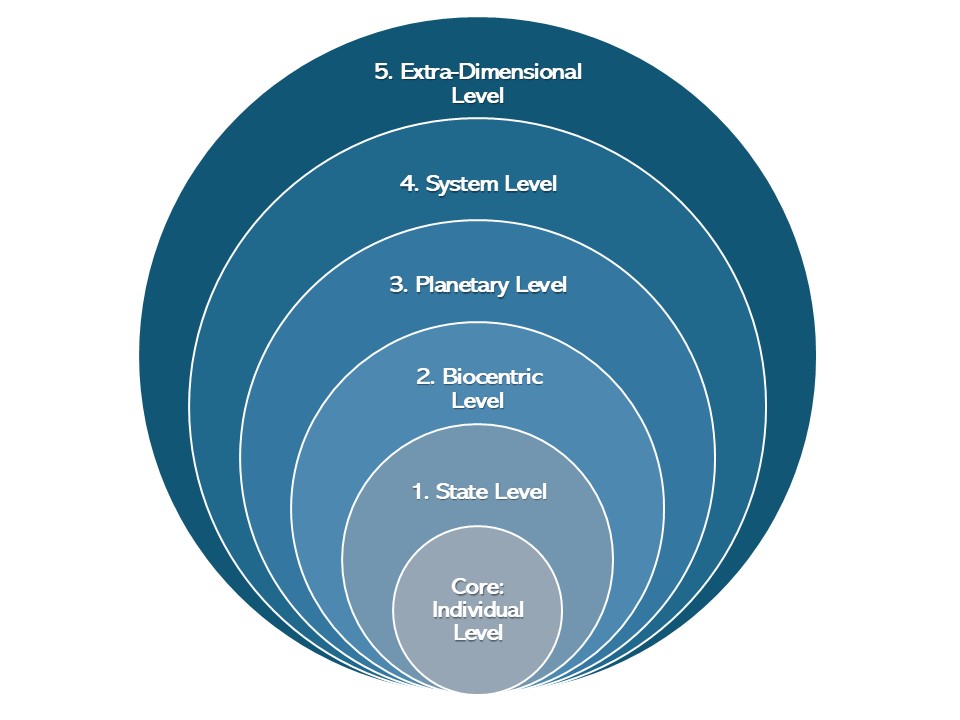
The pluralistic conception of a psychedelic Levels of Analysis in International Relations can be effectively arranged as holons, a concept derived from Arthur Koestler’s theory of holarchy. Holons are entities that are simultaneously wholes in themselves and parts of larger systems (Koestler 1967). In the context of IR, this arrangement would recognise that each level of analysis is both autonomous and interdependent, forming nested layers of complexity that interact dynamically.
This holonic structure emphasises inclusivity, interconnection, and the recursive nature of influence across levels, making it particularly suitable for the pluralistic framework outlined here. A holonic approach emphasises the nested and interdependent nature of global phenomena (Kavalski 2011), aligning with the pluralistic ethos of this expanded framework. The model enables analysis at any level without losing sight of connections to higher or lower levels of organisation.
By integrating non-human, planetary, cosmic, and extra-dimensional entities, the holonic structure accommodates diverse ontologies and emergent phenomena. Our understanding of Levels of Analysis as holons can evolve, allowing the framework to adapt as new forms of agency or interaction emerge (e.g., AI singularity or interstellar contact). In this section I outline the contours of this expanded Levels of Analysis, providing a brief definition of each level and its holonic role.
Core: Individual Level
At the core of the holarchy are individuals, encompassing humans, artificial intelligence (AI) systems, and sentient non-human beings. These entities are foundational units of agency, decision-making, and perception. While they operate autonomously, their actions are profoundly influenced by the layers above them, such as states, planetary systems, and cosmic dynamics.
Holonic role: Individual beings are both autonomous agents and components of larger collectives, such as states, ecosystems, or AI networks.
Level 1: State Level
States, traditionally seen as unitary actors in IR, are reimagined as entities intricately entangled with planetary and cosmic dynamics. States are composed of individuals, groups, and AI systems but are also shaped by broader forces, such as ecological constraints and global norms.
Holonic role: States are wholes composed of individuals and groups, yet they function as parts of the planetary and systemic holons above them.
Level 2: Biocentric Level
The biocentric level emphasises the agency of non-human life and ecosystems. Biocentric actors—including species, biomes, and ecological networks—both shape and are shaped by human and state-level actions. This level also foregrounds the role of biodiversity and ecosystems in global stability.
Holonic role: Biocentric systems are wholes that encompass intricate interactions among species and ecological processes, yet they are also parts of the planetary system.
Level 3: Planetary Level
The Earth is treated as a sentient and dynamic whole. Planetary systems—such as climate cycles, biodiversity networks, and geological processes—form the structural context for all subordinate holons. This level integrates Indigenous cosmologies that regard the Earth as a living entity with intrinsic rights and agency (Watts 2013; Boyd 2017).
Holonic role: The Earth is a holistic system encompassing all life forms, states, and individuals, while also being part of larger systemic and cosmic dynamics.
Level 4: System Level
This level addresses the broader system of interactions among human and non-human entities, including extraterrestrial civilisations and cosmic phenomena. It acknowledges the interdependence of planetary, biocentric, and state-level interactions within a larger cosmic framework.
Holonic role: The system level is a whole that includes planetary and biocentric processes while serving as part of the cosmic order.
Level 5: Extra-Dimensional Level
This level incorporates phenomena and beings that transcend observable space-time, drawing on theoretical physics, metaphysical traditions, and experiential accounts. Extra-dimensional entities influence and interact with systemic and planetary levels, yet they remain part of a larger ontological whole.
Holonic role: Extra-dimensional realities are wholes with their own internal dynamics, but they contribute to and influence the systemic and planetary holons.
Visualising the Levels of Analysis as a holarchy
The holonic arrangement, or holarchy, can be visualised as nested, interrelated layers:
- Core: Individual Level (humans, AI, and non-human intelligences).
- Level 1: State Level (collectives of individuals, AI systems, and institutions).
- Level 2: Biocentric Level (non-human life forms and ecosystems).
- Level 3: Planetary Level (Earth systems and global dynamics).
- Level 4: System Level (cosmic dynamics and interstellar interactions).
- Level 5: Extra-Dimensional Level (multi-dimensional entities and phenomena).
Arranging the pluralistic Levels of Analysis as holons provides a cohesive structure for understanding the interconnected dynamics of the emerging new International Relations. Each level is both an autonomous entity and a part of a larger system, operating autonomously within its sphere but also influenced by the dynamics of the holons above and below it.
Concluding thoughts
The “psychedelic” nature of this updated Levels of Analysis in IR lies in its radical expansion of perspectives, its embrace of interconnectedness, and its willingness to challenge traditional boundaries of thought. By integrating planetary dynamics, non-human agency, and multi-dimensional phenomena, it pictures a holistic and transformative approach to understanding International Relations as theory and practice. This paradigm shift reflects the ethos of psychedelia: to dissolve artificial separations, expand consciousness, and reimagine the possibilities of coexistence within a complex and interconnected universe.
Arranging the pluralistic Levels of Analysis as holons provides a cohesive structure for understanding the interconnected dynamics of modern IR. By recognising each level as both an autonomous entity and a part of a larger system, this imagines a transformative approach to IR scholarship and policymaking for the challenges of the Anthropocene and beyond.

References
(2010). Indigenous Peoples’ Declaration. World People’s Conference on Climate Change, 19–22 April 2010. Climate and Capitalism.
(2010). People’s Agreement on Climate Change and the Rights of Mother Earth. World People’s Conference on Climate Change, 19–22 April 2010. Climate and Capitalism.
Allison, G., and Zelikow, P. (1999). Essence of Decision: Explaining the Cuban Missile Crisis (2nd ed.). Longman.
Barad, K. (2007). Meeting the Universe Halfway: Quantum Physics and the Entanglement of Matter and Meaning. Duke University Press.
Bode, I. (2024). AI Technologies and International Relations: Do We Need New Analytical Frameworks? The RUSI Journal. 169(5), 66–74.
Bostrom, N. (2014). Superintelligence: Paths, Dangers, Strategies. Oxford University Press.
Boyd, D. R. (2017). The Rights of Nature: A Legal Revolution That Could Save the World. ECW Press.
Braidotti, R. (2013). The Posthuman. Polity Press.
Brynjolfsson, E., and McAfee, A. (2014). The Second Machine Age: Work, Progress, and Prosperity in a Time of Brilliant Technologies. W. W. Norton and Company.
Burke, A., Fishel, S., Mitchell, A., Dalby, S., & Levine, D. J. (2016). Planet Politics: A Manifesto from the End of IR. Millennium. 44(3), 499-523.
Bussey, M. (2009). Six shamanic concepts: charting the between in futures work. Foresight, 11(2), 29 – 42.
Chandler, D., Rothe, D., and Müller, F. (eds.). (2021). International Relations in the Anthropocene: New Agendas, New Agencies and New Approaches. Springer International Publishing.
Chakrabarty, D. (2009). The climate of history: Four theses. Critical Inquiry, 35(2), 197–222.
Criado, J. I., Sandoval-Almazán, R., & Gil-Garcia, J. R. (2024). Artificial intelligence and public administration: Understanding actors, governance, and policy from micro, meso, and macro perspectives. Public Policy and Administration. Pre-print.
Copy Citation
Cudworth, E., and Hobden, S. (2011). Beyond environmental security: Complex systems, multiple inequalities and environmental risks. Environmental Politics. 20(1), 42-59.
Cullinan, C. (2011). Wild Law: A Manifesto for Earth Justice. Chelsea Green Publishing.
Dalby, S. (2014), Rethinking Geopolitics: Climate Security in the Anthropocene. Global Policy. 5, 1-9.
Dolan, R. (2002). UFOs and the National Security State: Chronology of a Cover-up 1941–1973. Hampton Roads Publishing.
Doyle, M. W. (1986). Liberalism and world politics. American Political Science Review, 80(4), 1151–1169.
Eliade, M. (1959). The Sacred and the Profane: The Nature of Religion. Harcourt.
Fadiman, J. (2011). The Psychedelic Explorer’s Guide: Safe, Therapeutic, and Sacred Journeys. Inner Traditions/Bear.
Floridi, L. (2014). The Fourth Revolution: How the Infosphere is Reshaping Human Reality. Oxford University Press.
Gade, D. W. (2002). Scholars and shamans: the questing self as archetype. ReVision, 24(3), 39-45.
Grof, S. (1975). Realms of the Human Unconscious: Observations from LSD Research. Viking Press.
Grof, S. (1980). The Adventure of Self-Discovery: Dimensions of Consciousness and New Perspectives in Psychotherapy and Inner Exploration. State University of New York Press.
Habib, B. (2015). Climate Change, Security and Regime Formation in East Asia. In R. Pacheco Pardo and J. Reeves (Eds.), Non-Traditional Security in East Asia: A Regime Approach. Imperial College Press, 49-72.
Harari, Y. N. (2018). 21 Lessons for the 21st Century. Spiegel and Grau.
Haraway, D. J. (2016). Staying with the Trouble: Making Kin in the Chthulucene. Duke University Press.
Harner, M. (1982). The Way of the Shaman: A Guide to Power and Healing. New York: Bantam Books.
Harrison, A. A. (2007). Starstruck: Cosmic Visions in Science, Religion, and Folklore. Berghahn Books.
Hoffmeyer, J. (2008). Biosemiotics: An Examination into the Signs of Life and the Life of Signs. University of Scranton Press.
Jervis, R. (1976). Perception and Misperception in International Politics. Princeton University Press.
Kahneman, D., and Tversky, A. (1979). Prospect theory: An analysis of decision under risk. Econometrica, 47(2), 263–291.
Kaplan, J. (2016). Artificial Intelligence: What Everyone Needs to Know. Oxford University Press.
Kavalski, E. (2007). The fifth debate and the emergence of complex international relations theory: notes on the application of complexity theory to the study of international life. Cambridge Review of International Affairs. 20(3), 435-454.
Kavalski, E. (2011). From the Cold War to Global Warming: Observing Complexity in IR. Political Studies Review. 9(1), 1-12.
Keck, M. E., and Sikkink, K. (1998). Activists beyond Borders: Advocacy Networks in International Politics. Cornell University Press.
Keohane, R. O. (1984). After Hegemony: Cooperation and Discord in the World Political Economy. Princeton University Press.
Keohane, R. O., and Nye, J. S. (1977). Power and Interdependence: World Politics in Transition. Little, Brown and Company.
Kershenbaum, A. (2020). The Zoologist’s Guide to the Galaxy. Viking Press.
Koestler, A. (1967). The Ghost in the Machine. Hutchinson.
Latour, B. (2007). Reassembling the Social: An Introduction to Actor-Network-Theory. Oxford University Press.
Latour, B. (2017). Facing Gaia: Eight Lectures on the New Climatic Regime. Polity Press.
Loeb, A. (2021). Extraterrestrial: The First Sign of Intelligent Life Beyond Earth. Houghton Mifflin Harcourt.
Lovelock, J. (2000). Gaia: A New Look at Life on Earth. Oxford University Press.
Mearsheimer, J. J. (2001). The Tragedy of Great Power Politics. W. W. Norton and Company.
Metzner, R. (2013). Entheogenic rituals, shamanism and green psychology. European Journal of Ecopsychology. 4, 64-77.
Metzner, R. (1998). The Unfolding Self: Varieties of Transformative Experience. Origin Press.
Pollan, M. (2018). How to Change Your Mind: The New Science of Psychedelics. Penguin Press.
Race, M. S., and Randolph, R. O. (2002). The need for operating guidelines in astrobiology: Preventing contamination and fostering ethical research. Space Policy, 18(4), 331–340.
Rockström, J., et al. (2009). A safe operating space for humanity. Nature, 461(7263), 472–475.
Rosenau, J. N. (1966). Pre-theories and theories of foreign policy. In R. Barry Farrell (Ed.), Approaches to Comparative and International Politics. Northwestern University Press, 27–92.
Safina, C. (2016). Beyond Words: What Animals Think and Feel. Henry Holt.
Senn, H. A. (1989). Jungian Shamanism. Journal of Psychoactive Drugs, 21(1), 113-121.
Strassman, R. (2000). DMT: The Spirit Molecule. Park Street Press.
Tapscott, D., and Tapscott, A. (2016). Blockchain Revolution: How the Technology Behind Bitcoin is Changing Money, Business, and the World. Portfolio.
Tarnas, R. (1991). The Passion of the Western Mind: Understanding the Ideas That Have Shaped Our World View. Ballantine Books.
Tegmark, M. (2017). Life 3.0: Being Human in the Age of Artificial Intelligence. Knopf.
Vakoch, D. A. (2013). Extraterrestrial Altruism: Evolution and Ethics in the Cosmos. Springer.
Waltz, K. N. (1959). Man, the State, and War: A Theoretical Analysis. Columbia University Press.
Waltz, K. N. (1979). Theory of International Politics. Addison-Wesley.
Watts, V. (2013). Indigenous place-thought and agency amongst humans and non-humans. Decolonisation: Indigeneity, Education and Society, 2(1), 20–34.
Zuboff, S. (2019). The Age of Surveillance Capitalism: The Fight for a Human Future at the New Frontier of Wheeler, J. A. (1990). Information, physics, quantum: The search for links. Proceedings of the 3rd International Symposium on Foundations of Quantum Mechanics.
A psychedelic Levels of Analysis in International Relations by Benjamin Habib is licensed under CC BY 4.0

 Edge Dwellers Café
You must be logged in to post a comment.