
- Human security paradigm
- Critically evaluating the human security paradigm
- Learning activity: Exploring human security through cross-impact analysis
- Summary
- References

The study of International Relations increasingly demands engagement with paradigms that extend beyond traditional notions of state power and sovereignty. One such framework is human security, introduced by the United Nations Development Programme (UNDP) in its seminal Human Development Report 1994.
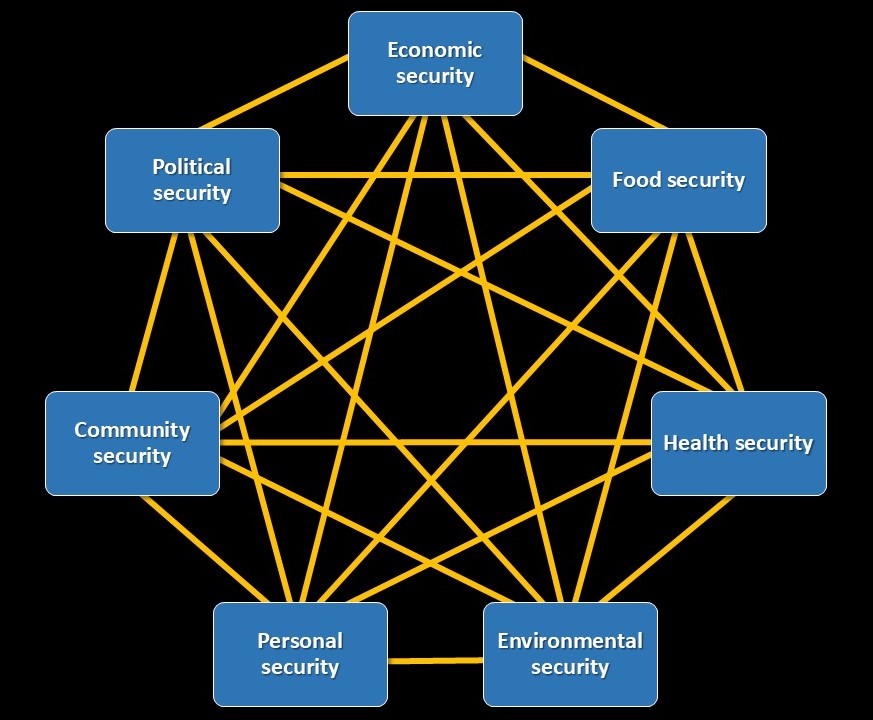
Unlike conventional security frameworks that focus primarily on military power and territorial integrity, the human security paradigm shifts the focus to individuals, emphasising the protection of their dignity, freedoms, and basic needs. It incorporates seven interrelated dimensions:
- Economic security
- Food security
- Health security
- Environmental security
- Personal security
- Community security
- Political security
This multidimensionality provides an integrated lens through which to explore the complex relationships for forces that shape the lived realities of people during of challenging events.
For undergraduate students of International Relations, the human security paradigm challenges traditional assumptions, fosters critical thinking, and equips students with the tools to engage with contemporary global issues in a holistic manner.
Inspired by class activities I developed for undergraduate subjects International Politics of Climate Change (POL3IPC) and States, Security and International Relations (POL1SNS) at La Trobe University, this article provides an in-depth briefing on the human security framework, along with a structured learning activity based on Cross-Impact Analysis of a location-specific human security case study. These components are designed to support active learning and foster a nuanced understanding of the interplay between human vulnerabilities and systemic global challenges.

Human security paradigm
The concept of human security, as articulated in the 1994 United Nations Development Programme’s Human Development Report (1994), represents a significant shift from traditional state-centred approaches to security, towards a more holistic, people-focused framework. Unlike conventional paradigms, which prioritise state sovereignty and territorial integrity (Buzan et al 1998; Baldwin 1997), human security emphasises the protection of individuals from pervasive and critical threats while ensuring their dignity and enabling opportunities for flourishing (King and Murray 2001). The report identifies seven interlinked dimensions of human security—economic, food, health, environmental, personal, community, and political security—each addressing specific yet interconnected aspects of human vulnerability and resilience.
Economic security
Economic security underpins human security by ensuring individuals have access to stable and sufficient income to meet their basic needs (UNDP 1994). This dimension is intrinsically tied to poverty reduction and sustainable livelihoods, as underscored by the works of Sen (1999) and Sachs (2005). In contexts of unemployment, underemployment, and widening income inequality, economic insecurity exacerbates societal instability and hinders development (Collier and Hoeffler 2004). This is particularly acute in low-income nations, where persistent poverty and structural barriers to economic opportunity exacerbate vulnerabilities across other dimensions of security (World Bank 2018).
Food security
Food security, a second critical dimension, ensures reliable access to sufficient, safe, and nutritious food for an active and healthy life (FAO 2010). The UNDP’s framing goes beyond the mere availability of food, focusing instead on equitable access and distribution (Pingali 2007). Marginalised communities are disproportionately affected by food insecurity, with consequences ranging from malnutrition to social unrest (Barrett 2010; Maxwell & Smith 1992). Challenges such as climate change (Habib , conflict, and trade restrictions further compound food insecurity, with the impacts most acutely felt in regions like Sub-Saharan Africa and South Asia (IPCC 2014; Keats & Wiggins 2010).
Health security
Health security, as outlined in the report, centres on safeguarding individuals from preventable diseases, poor healthcare, and unsafe living conditions (UNDP 1994). This dimension has gained renewed attention in light of global health crises, including HIV/AIDS, the Ebola outbreak (Garrett 1994) and more recently the COVID-19 pandemic (Kickbusch et al 2020). Disparities in healthcare access between high- and low-income countries underscore how health insecurity exacerbates existing inequalities and impedes global development (Farmer 2003; Marmot 2004).
Environmental security
Environmental security concerns the preservation of ecosystems and mitigation of environmental degradation, recognising their critical role in supporting human life and well-being (UNDP 1994). Issues such as climate change, deforestation, biodiversity loss, and water scarcity pose existential threats, particularly for vulnerable populations (IPCC 2014; Stern 2007). Environmental insecurity is further linked to forced migration (Song & Habib 2020), resource conflicts, and socio-economic inequalities, as evidenced by research into environmental migration and the role of natural resource scarcity in conflict (Homer-Dixon 1999; Kelly & Adger 2000).
Personal security
Personal security involves protecting individuals from violence and the threat of harm, encompassing domestic abuse, crime, and state-sponsored violence (UNDP 1994). This dimension intersects with broader debates on human rights and the role of legal and social frameworks in ensuring safety and justice (Amnesty International 2019; Human Rights Watch 2021). Studies reveal that high levels of personal insecurity can destabilise societies and severely impede development efforts (Fearon & Laitin 2003).
Community security
Community security addresses the protection of cultural identity and social cohesion, particularly for groups at risk of discrimination, marginalisation, or displacement (UNDP 1994). This dimension highlights the importance of fostering inclusion and mitigating ethnic, sectarian, and communal tensions (Putnam 2020). Forced migration and refugee crises illustrate how community security is eroded during conflicts, with long-term implications for stability and reconciliation (Kaldor 2013; Betts 2013).
Political security
Political security concerns the safeguarding of individuals’ basic rights and freedoms, ensuring freedom from political repression and systemic exclusion (UNDP 1994). This dimension ties closely to democratic governance, accountability, and adherence to the rule of law. Political insecurity—often manifesting as authoritarianism, corruption, or the suppression of dissent—undermines both individual freedoms and broader societal stability (Acemoglu & Robinson 2012; North et al 2009). This can also erode the stability and legitimacy of political systems by overwhelming governance capacities (Habib 2010).

Critically evaluating the human security paradigm
While the paradigm has been widely celebrated for its innovative approach, it is not without its challenges. Below is a detailed discussion of its strengths and weaknesses, based on scholarly analysis.
Strengths of the human security paradigm
Comprehensive framework: Human security’s focus on multiple dimensions—economic, food, health, environmental, personal, community, and political security—offers a holistic approach to addressing the interconnected and multi-dimensional threats faced by individuals (UNDP 1994; Gasper 2006). This integrative perspective allows policymakers to identify and address root causes of insecurity rather than just symptoms.
Focus on individual well-being: Unlike traditional security paradigms that prioritise state sovereignty, human security centres on individuals and their experiences of vulnerability (King and Murray 2001). This approach ensures that marginalised populations, often overlooked in state-centred policies, receive adequate attention.
Relevance to global issues: The paradigm is particularly well-suited to addressing transnational and non-traditional security threats such as climate change, pandemics, and global poverty. These issues, which transcend national borders, require solutions that go beyond military and territorial concerns (Paris 2001; Kaldor 2013).
Promotion of human rights and development: Human security aligns closely with the promotion of universal human rights and sustainable development. It emphasises freedom from fear and freedom from want, directly linking security to development outcomes (Sen 1999; Sachs 2005).
Emphasis on prevention: By identifying vulnerabilities and addressing systemic inequalities, the paradigm facilitates proactive interventions that can prevent conflicts and crises, reducing long-term costs (Collier and Hoeffler 2004; Alkire 2003).
Critiques of the human security paradigm
Conceptual ambiguity: Critics argue that the broad and inclusive nature of human security makes it difficult to define and operationalise (Paris 2001; Newman 2010). The inclusion of diverse dimensions can dilute its analytical focus, leading to debates over prioritisation and implementation.
Policy implementation challenges: Translating human security principles into actionable policies requires significant institutional coordination across sectors such as health, environment, and governance. This complexity often results in fragmented or inconsistent responses (Chandler 2008).
Resource intensiveness: Addressing all dimensions of human security simultaneously can strain limited resources, particularly in low-income countries. Balancing short-term needs with long-term objectives often poses significant challenges (World Bank 2018).
Potential for politicisation: The paradigm’s focus on human rights and individual welfare can lead to accusations of interference in state sovereignty. Some governments perceive human security as a tool for external actors to justify intervention in domestic affairs (Acharya 2001).
Limited applicability in armed conflict: Critics argue that human security’s focus on non-military threats may not adequately address traditional security concerns in situations of armed conflict or interstate war (Krause 2004).
Measurement difficulties: The multi-dimensional nature of human security makes it challenging to develop robust metrics for assessing progress. Existing measures often rely on proxies that may not capture the complexity of individual experiences (Alkire 2003).

Learning activity: Exploring human security through cross-impact analysis
This structured learning activity will enable students to explore the interrelated dimensions of human security using Cross-Impact Analysis. By the end of the activity, students will understand how different dimensions of human security influence one another, as articulated in the UNDP Human Development Report (1994).
This activity is designed to develop students’ understanding of the human security paradigm and its application to a specific real-world case study, and foster analytical thinking, teamwork, and the ability to synthesise complex interconnections—all vital skills for students of International Relations.
Methodology
This learning activity combines the structured analytic technique of cross-impact analysis, using the seven dimensions of human security (UNDP 1994), in the context of a specific case study.
Cross-impact analysis
Cross-impact Analysis, as described by (2020) in Structured Analytic Techniques for Intelligence Analysis (3rd ed.), is a structured analytic technique used to evaluate the interrelationships and mutual influences among a set of variables, events, or factors within a complex system (Pherson and Heuer 2020, Chapter 7.3). This technique enables analysts to systematically examine how the occurrence or change in one factor might impact others, thereby identifying potential cascading effects and interdependencies.
“The Cross-Impact Matrix helps analysts deal with complex problems when “everything is related to everything else.” By using this technique, analysts and decision makers can systematically examine how each factor in a context influences all other factors to which it appears related” (Pherson and Heuer 2020, 272).
Cross-impact Analysis involves constructing a matrix where variables or events are listed on both axes, allowing for the identification of direct and indirect impacts between them. Analysts assess the strength and direction of these relationships, often using qualitative ratings (e.g., high, medium, low) or quantitative scoring.
This technique is particularly valuable for exploring scenarios, assessing risks, and identifying critical leverage points in dynamic systems. It is also useful in addressing uncertainty by revealing hidden dynamics and fostering deeper understanding of complex problems.
Cross-impact matrix for human security
To examine the seven inter-related dimensions of human security in this activity, students will use this cross-impact matrix:
Choosing a case study
A cross-impact analysis of human security will make more sense for students in the context of a case study.
Case study analysis using the human security framework outlined in the UNDP Human Development Report 1994 involves applying the framework’s seven dimensions—economic, food, health, environmental, personal, community, and political security—to examine how vulnerabilities and threats manifest within a specific context or population. This approach enables a holistic understanding of the interplay between diverse factors affecting human well-being and security, offering insights into both location-specific root causes and broader systemic dynamics.
For instance, a location-specific case study might analyse:
- Economic insecurity through metrics such as unemployment rates and income disparities, while also considering food security by assessing access to nutrition amidst disrupted supply chains.
- Health security could be examined in terms of the prevalence of preventable diseases and access to medical care.
- Environmental security might focus on the impact of resource scarcity or ecological degradation.
- Personal and Community security would involve evaluating levels of violence, discrimination, or displacement.
- Political security could be assessed by examining the protection of rights and freedoms or governance failures.
This multi-dimensional approach ensures that case studies address the interconnected and context-specific nature of human insecurity, providing a comprehensive basis for policy recommendations and interventions aimed at fostering resilience and sustainable development.
Activity instructions
This learning activity includes a combination of pre-class preparation, in-class discussion-based application of cross-impact analysis by students in small groups (3-4 students), and a whole-of-class reflection on the findings of the group activity. It incorporates individual preparation and research, and small group collaboration.
The activity can also include an assessable written component, when students submit a short essay, report or blog posting on their findings from their group’s cross-impact analysis of their chosen case study.
Stated timing for each stage of the activity are suggestive only and can be adjusted according to time length of class, class size, room layout, in-person vs online mode etc.
Students should have access to either a PC, laptop, tablet and/or smartphone to access the internet during this activity.
Pre-class preparation
Each student should individually prepare for their participation in the in-class component of the learning activity by completing the following:
Assigned reading: Students are required to read the briefing notes above, along with the relevant sections of the UNDP Human Development Report 1994, focusing on the seven dimensions of human security:
- Economic security
- Food security
- Health security
- Environmental security
- Personal security
- Community security
- Political security
Watch topic content: Students watch the live lecture or online content video (linked in the Learning Management System) explaining human security as a concept and its application to International Relations.
Introduction to cross-impact analysis: Students read Chapter 7.3 of Structured Analytic Techniques for Intelligence Analysis (3rd ed.) by Pherson and Heuer (2020) explaining Cross-Impact Analysis.Preparation task: Students should bring a copy of the matrix chart to class (digital or printed) and prepare by identifying one example of a current issue (e.g., climate change, conflict, or pandemics) that could affect human security in a specific location.
In-class activity (90 minutes)
The in-class elements of this learning activity will include the following steps:
Introduction (10 minutes): The instructor provides a brief overview of Cross-Impact Analysis and outlines the purpose of the activity:
- Goal: To collaboratively map interconnections between dimensions of human security and explore the implications for policymaking.
Group formation (5 minutes): Students are divided into groups of 4-6, ensuring a mix of perspectives in each group. Each group is assigned a facilitator and a note-taker.
Group work – Conducting the analysis (50 minutes)
Step-by-step instructions
1. Defining the context (10 minutes): Each group selects a specific global issue from the examples brought by group members (e.g., climate change, global food crises, pandemics). Groups discuss how this issue impacts at least two dimensions of human security.
2. Filling the matrix (25 minutes): Groups use the matrix chart to systematically explore the interconnections between all seven dimensions of human security. For each intersection, groups discuss the direction and strength of the impact:
- Direction: Does Dimension A positively or negatively affect Dimension B?
- Strength: Is the relationship weak, moderate, or strong?
3. Group insights (15 minutes): Each group identifies the two most significant interconnections they’ve mapped and discusses the broader implications for policy.
4. Informal group sharing (20 minutes): Each group shares their findings with the class, focusing on their selected global issue, the most critical interconnections, and the implications for human security. The instructor facilitates discussion, encouraging comparisons between groups and asking probing questions to deepen analysis.
5. Class debrief (10 minutes): The instructor wraps up with reflections on the value of Cross-Impact Analysis:
- Why it matters: Understanding interconnections aids in designing integrated policies and responses to global challenges.
- Takeaways: Students consider how this technique applies to real-world policy analysis in International Relations.
6. Written assessment (optional): The activity can also include an assessable written component, when students submit a short essay, report or blog posting on their findings from their group’s cross-impact analysis of their chosen case study.

Summary
The seven dimensions of human security demonstrate the interconnectedness of human vulnerabilities and the importance of addressing them holistically. Together, they provide a comprehensive framework for promoting human welfare and dignity, situating human security at the nexus of development, governance, and global cooperation.
The human security paradigm represents a vital evolution in security studies, shifting the focus from states to individuals and addressing a broad spectrum of threats. However, its conceptual breadth and practical challenges necessitate careful consideration in both academic and policy contexts. By balancing its ambitious vision with pragmatic strategies for implementation, human security has the potential to make significant contributions to global peace and development.
References
Acemoglu, D., & Robinson, J. A. (2012). Why Nations Fail: The Origins of Power, Prosperity, and Poverty. Crown Business.
Acharya, A. (2001). Human Security: East versus West. International Journal. 56(3), 442–460.
Alkire, S. (2003). A Conceptual Framework for Human Security. Centre for Research on Inequality, Human Security and Ethnicity (CRISE). University of Oxford.
Amnesty International. (2019). Human Rights in the World: Annual Report.
Barrett, C. B. (2010). Measuring Food Insecurity. Science. 327(5967), 825–828.
Betts, A. (2013). Survival Migration: Failed Governance and the Crisis of Displacement. Cornell University Press.
Buzan, B., Waever, O., & De Wilde, J. (1998). Security: A New Framework for Analysis. Lynne Rienner Publishers.
Chandler, D. (2008). Human Security: The Dog That Didn’t Bark. Security Dialogue. 39(4), 427–438.
Collier, P., & Hoeffler, A. (2004). Greed and Grievance in Civil War. Oxford Economic Papers. 56(4), 563–595.
Food and Agriculture Organization (FAO). (2010). The State of Food Insecurity in the World 2010: Addressing Food Insecurity in Protracted Crises.
Farmer, P. (2003). Pathologies of Power: Health, Human Rights, and the New War on the Poor. University of California Press.
Fearon, J. D. & Laitin, D. D. (2003). Ethnicity, Insurgency, and Civil War. American Political Science Review, 97(1), 75–90.
Garrett, L. (1994). The Coming Plague: Newly Emerging Diseases in a World Out of Balance. Farrar, Straus and Giroux.
Gasper, D. (2006). Securing Humanity: Situating ‘Human Security’ as Concept and Discourse. Journal of Human Development, 6(2), 221–245.
Habib, B. (2010) Climate Change and Regime Perpetuation in the DPRK. Asian Survey. 50(2), 378-401.
Homer-Dixon, T. (1999). Environment, Scarcity, and Violence. Princeton University Press.
Human Rights Watch. (2021). World Report 2021: Events of 2020.
Intergovernmental Panel on Climate Change (IPCC). (2014). Human Security. In Climate Change 2014 – Impacts, Adaptation and Vulnerability: Part A: Global and Sectoral Aspects: Working Group II Contribution to the IPCC Fifth Assessment Report. Cambridge University Press, 755-792.
Kaldor, M. (2013). Human Security. Polity Press.
Keats, S. & Wiggins, S. (2010). Impact of the global food crisis on the poor: what is the evidence? ODI Global.
Kelly, P. M. & Adger, W. N. (2000). Theory and Practice in Assessing Vulnerability to Climate Change and Facilitating Adaptation. Climatic Change. 47(4), 325–352.
Kickbusch, I., Leung, G. M., Bhutta, Z. A., Matsoso, M. P., Ihekweazu, C., & Abbasi, K. (2020). COVID-19: How a Virus Is Turning the World Upside Down. BMJ, 369, m1336.
King, G., & Murray, C. J. (2001). Rethinking Human Security. Political Science Quarterly. 116(4), 585–610.
Krause, K. (2004). The Key to a Powerful Agenda, If Properly Delimited. Security Dialogue, 35(3), 367–368.
Marmot, M. (2004). The Status Syndrome: How Social Standing Affects Our Health and Longevity. Times Books.
Maxwell, S., & Smith, M. (1992). Household Food Security: A Conceptual Review. In Maxwell, S., Frankenberger, T. R. (1992). Household food security: Concepts, indicators, measurements: A technical review. UNICEF/IFAD, 1–72.
Newman, E. (2010). Critical Human Security Studies. Review of International Studies. 36(1), 77–94.
North, D. C., Wallis, J. J., & Weingast, B. R. (2009). Violence and Social Orders: A Conceptual Framework for Interpreting Recorded Human History. Cambridge University Press.
Paris, R. (2001). Human Security: Paradigm Shift or Hot Air? International Security, 26(2), 87–102.
Pherson, R.H. and Heuer, R.J. (2020). Structured Analytic Techniques for Intelligence Analysis (3rd Ed.). SAGE Publishing.
Pingali, P. (2007). Westernisation of Asian Diets and the Transformation of Food Systems: Implications for Research and Policy. Food Policy. 32(3), 281–298.
Putnam, R. D. (2020). Bowling Alone: The Collapse and Revival of American Community (Revised Edition). Simon and Schuster.
Sachs, J. D. (2005). The End of Poverty: Economic Possibilities for Our Time. Penguin Press.
Sen, A. (1999). Development as Freedom. Knopf.
Song, J. & Habib, B. (2020) The hidden variable: environmental migration from North Korea. The Pacific Review. 34(6), 973-994.
Stern, N. H. (2007). The Economics of Climate Change: The Stern Review. Cambridge University Press.
United Nations Development Programme (UNDP). (1994). Human Development Report 1994.
World Bank. (2018). Poverty and Shared Prosperity 2018: Piecing Together the Poverty Puzzle. World Bank Group.
 Edge Dwellers Café
You must be logged in to post a comment.