I relate more to alien worlds and extra-terrestrial beings, witches and wizards, zombies and vampires, more than the world I live in.
This article was originally published at Benny Got Burnout.
It’s a warm late-summer night. The shining incomplete disc of a waning gibbous moon rises slowly be inexorably behind a dark silhouette of gum trees. Legions of cicadas chirp in unison down in the creek bed, a calming soundtrack as I read Alastair Reynolds novel Elysium Fire by lamplight.
I love reading outside at night. I used to sit under the back porch of my old house in suburban Melbourne, propped up on a deck chair, reading books under the illumination of a re-purposed bedside lamp. The lamp was too classy for the cobwebs it was covered in. The 86 tram would rattle away in the distance under the watchful summer gaze of the Orion constellation and Sirius, my favourite stars whose springtime arrival herald the warmer months each year.
Perhaps my attachment to these stars has some connection with my love for sci-fi and fantasy fiction. Alien worlds and extra-terrestrial beings, witches and wizards, zombies and vampires, are all more relatable to me than the culture of bigotry, cruelty and greed that embody everyday life in the banal shit hole of late-stage capitalism in Australia.
Sci-fi and fantasy fiction have long been a special interest of mine. I’m just old enough to have been a young kid when the original Star Wars trilogy became a cultural phenomenon. My most prized Lego model was an X-wing star fighter. I mastered Chewbacca’s Wookiee growl as a teen, though it did not make me more attractive to girls.
I started high school watching the premier season of the X-Files on TV. I had nightmares of the spectral presence encountered by fictional NASA astronaut Aurelius Belt in S01E09, an apparition based loosely on the famous Cydonia Face on Mars.
Fantasy fiction emerged on my radar in Year 10 English class, in which we read J.R.R. Tolkien’s The Hobbit as a text. As our teacher, Mr Hart, handed out tattered copies of the book, he launched into what I assume was his annual pre-emptive strike: “Now boys…” — very deliberately not addressing the females in the class — “…the main character’s name is ‘Bilbo’. Yes, Bilbo rhymes with dildo. Have a laugh, get it out of your system.” We laughed and laughed like the dumb country boys that we were.
Thankfully my interest in the fantasy genre survived Mr Hart’s inauspicious introduction. I read Lord of the Rings a few years later, then was mesmerised by the Peter Jackson’s incredible movie trilogy adaptation a few years after that.
I first watched Lord of the Rings: Fellowship of the Ring in Beijing, at the tail end of a semester studying in South Korea and China. From country South Australia to Seoul, Frodo’s hero’s journey from the Shire into the larger world of Middle Earth reflected the trials and triumphs of personal awakening in my own trip abroad.
When I first succumbed to burnout in 2022, as I cloistered myself from the world while on stress leave, sci-fi and fantasy fiction literature was the safe space I immersed myself in for escape and recalibration. As the walls closed in around me in real life, I began exploring other worlds through the books I was reading. Now that I was on stress leave, with time in abundance and a burning need to decompress, I had space to journey long and deep into the imaginal realms of space and fantasy.
I have never read as many fiction books as I have over the past three years. Through the peak of my academic career, reading time meant wading through books and journal articles about world affairs and political history. Academic reading was invigorating when I was an PhD student, but by the time I reached mid-career it had become a tedious chore. Fiction reading was quarantined to the short sliver of time before bed, when I would nibble away at a few pages before sleep.
It was still in chilly August that I began my forced sabbatical immersed in the world of anthropomorphised insects, arachnids and crustaceans in the ten-novel Shadow’s of the Apt fantasy series by Adrian Tchaikovsky. The Shadows of the Apt novels explored themes of industrialisation and imperialism in a time of mass technological change, speaking to themes of the tensions between tradition and progress, magical and mechanistic ways of knowing, and the painful compromises of political necessity in a changing world.
Tucked in bed under a doona, with a hot coffee and some Tim Tams, I devoured each novel in 4-5 days. Reflecting on Shadows of the Apt three years later, the themes of the chaos caused by progress and rapid change feel all the more relevant as AI usurps human labour and the automates the war machines of the world’s great powers.
I liked Adrian Tchaikovsky’s world-building, so after finishing the Shadows of the Apt novels I moved on to his Final Architecture space opera series, set in a galactic multi-polar order of human and alien civilisations which have been apocalyptically disrupted by colossal plant-destroying entities called the Architects. Final Architecture centres on the diverse crew of a space salvage vessel that includes humans, aliens, neurodivergent and disabled bad-arses. Through the series, they overcome collapsing societies and mass evacuations from planets under attack, webs of political intrigue between powerful factions, and their own personal frailties. In spite of these ubiquitous challenges, they show up for each other and help others where they can.
Space operas centre the type imperfect wierdos who I can imagine myself as. The Palladium Wars novel series by Marko Kloos portrays a fractured post-imperial order in the Gaia solar system, in which its protagonists, a group of misfits running from tragic back-stories, who are crewing a cargo ship while attempting to survive and rebuild their lives in the wake of catastrophic war. I strongly relate to finding resilience and meaning in the hostile vacuum of space, dodging and weaving politics and social mores beyond my control.
I was a huge fan of The Expanse television series, based on the series of nine books by nom-de-plume James S.A. Corey, which recreated the first, second and third worlds of Cold War politics in a future solar system locked in Cold War between Earth, Mars and the Belt. In this volatile political environment, a shady corporation conducts secret research into an alien life form called the “protomolecule”, possession of which could (and did) alter the balance of power in the solar system. This universe-building was like catnip for me as an International Relations academic with a love for hard sci-fi space operas with political themes.
Before The Palladium Wars, Marko Kloos wrote the eight-book Frontline series, in which a future Earth, over-populated and economically stratified, is divided between a few political entities who have established off-planet colonies, linked by faster-than-light travel along interstellar space lanes. The books follow first contact and ongoing conflict with a species of giant alien creatures called “lankies”, from the first-person perspective of an individual soldier, Andrew Grayson. The series follows his career from enlisted grunt to commissioned officer as the conflict moves progressively from engaging the lankies on far-away colony planets to the defence of Earth from lankie invasion.
When the universe is churning with chaos, what is mine to do? Across Grayson’s career arc in the navy of the North American Commonwealth, he is called to step up in ways appropriate to his role. He concentrates on doing his immediate job, with the goal of getting back to his lover Haley, not trying to save all of humanity. In our own self-destructing world in 2026, what might it mean for me to resist self-righteous overreach and concentrate on what’s mine to do? It’s a question I return to on a daily basis.
Everyday life is a grind of confusion, anxiety and limitation. Sci-fi and fantasy fiction, however, is a space of diversity and possibility. Whether through book, TV, movie or song, I see the universe-building of sci-fi and fantasy fiction through my creative imagination, an limitless realm to explore and fantasise and play.
Where physical and psychological safety in everyday reality requires conformity and masking, sci-fi and fantasy fiction opens informed speculations on the deepest questions about the human experience and the nature of existence. It’s the perfect vehicle for cultivating self-acceptance and safe space for burnout processing and recovery.
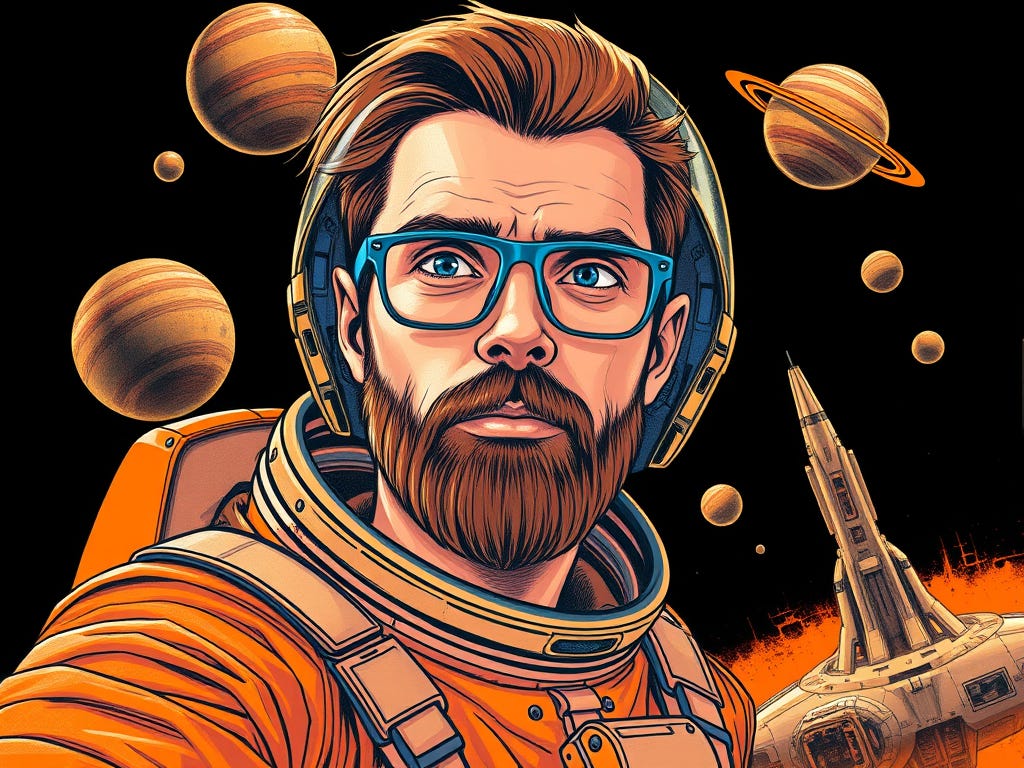
AI disclosure statement: The WordPress AI image generator was used to create the thumbnail image for this article.

