Still weird as ever, but without the old job title as a proxy for who I am.
This article was originally published at Benny Got Burnout.

It’s a hot night and I’m nervous.
I’ve driven into the CBD in sporting business-casual below the waste in black chinos while all scruffy on top in my tatty old Napalm Death t-shirt. I’m on my way to my first event as a new member of the South Australian chapter of the Australian Institute of International Affairs, ideally to make some new connections and find a spark of inspiration for my next career move.
I don’t want to sweat up my brand-new light blue coloured polo shirt while I’m driving, so the polo shirt is neatly folded riding shotgun on the passenger seat, along with a can of deodorant and a packet of Skittles. After parking my car in a high-rise car park, I swap the Napalm Death t-shirt for the nicely ironed polo, feeling stylish with a fresh haircut to complement my new top.
Then I look down. The polo shirt now has a dark blue stain the size of a ten-cent coin in the middle of my chest. It looks like I’ve been shot with a paint ball. I can’t believe the polo shirt is stained before I’ve even worn it. Ordinarily it takes splashback from a phở noodle soup or a curry with turmeric-infused gravy to get a shirt this dirty. The deodorant can is the culprit, a dribble from its nozzle responsible for the paintball mark on the shirt. Seriously, fuck.
The Napalm Death t-shirt won’t get it done at an AIIA event, but what am I worried about? I’m not an academic anymore, I’m just here as an International Relations enthusiast looking to meet some new people. I go with the now imperfect polo shirt because it’s a more professional look, though I’m no longer feeling fresh glow I was shining with five minutes ago.
Attending the event required careful logistical planning to calculate the least anxiety-inducing route into the city. The train was not an option. The venue was too far from the train station to walk comfortably in business-casual wear, and I didn’t want to be jammed into a train carriage full of peak hour commuters on a warm night. Driving into town was the option of choice, even if it entailed battling through peak hour traffic and pre-paying for a spot in the high-rise car park nearest to the venue. I don’t want to waste spoons in getting to the venue because I need them for the main event.
I arrive at the venue early. When planning any type of trip, I always allow some additional time to buffer against unforeseen obstacles and disruptions to avoid arriving late. Neither were a problem this evening, so I’ve got time to kill in all my beautiful awkwardness.
The event is being hosted in a specialty gin bar that’s nestled down an alleyway, around the corner from a pub I used to drink at as an undergrad. The bar is largely empty. My Doc Martens clomp on the hardwood floor as I circle the premises in search of familiar faces.
There’s a group of men in business suits, ties and leather shoes talking around a bar table. I don’t know these guys and like the “Scum” motif on my Napalm Death t-shirt, I’m naturally suspicious of men in business suits. I don’t approach, heading over the bar instead. The wall behind the bar is stacked two meters high with bottles of different types of gin. The young bartender asks what I want to drink. “Asking for a G&T seems a bit redundant in this place”, I joke. “What do you recommend?” The bartender is smooth and cool as shit, and he suggests a local boutique gin. He pours the drink, with a slice of lime and a sprig of rosemary. He’s right, it is a smooth G&T.

I walk upstairs to the seminar room, where there’s nothing going on yet, then back down for a couple of minutes, then back up the stairs again. Still nothing happening. I descend the stairs and sit outside with my G&T, cursing my desperate need for obsessive over-punctuality. More people arrive. There’s action upstairs now, so I climb the staircase once again.
There is a sign-in desk at the top of the stairs. I show my ticket and am given a blank white sticker on which to write my name, title and institutional affiliation. In the old days I would have confidently written “Dr Ben Habib, Senior Lecturer in International Relations, Generic Victorian University”. But today, I work as a glorified undergraduate tutor for a private provider that no-one has heard of, which services the online teaching of a degree program at a university in another city. I enjoy my current role, but it doesn’t have anywhere near the same professional cache of my old Senior Lecturer role.
I briefly consider writing my title as “Independent Substack Raconteur” but chicken out. Benny Bookshelf is not ready to be out and proud in this world. Maybe I’ll save that title for when I turn on paid subscriptions. I also consider placing my name tag over the stain on my shirt, but it would look odd plastered over my sternum.
I say “hi” to the first person I see who is standing alone, who turns out to be a retired academic from the University of Adelaide. She cocks her head and stares at my name tag in an exaggerated motion, the way people do at events like this when they meet new people. We make small talk laughing about the balls-up of the merger between the University of Adelaide and the University of South Australia, which is like talking cod-shit about the weather in South Australian academic circles. “Merger” is a euphemistic kindness for describing how the University of Adelaide swallowed UniSA whole. She asks if I know an old colleague of hers in Melbourne. Of course I don’t, but it’s small talk so we go through the motions. In a way it’s nice though, initiating a conversation with someone does take the edge off my nerves.
Another guy comes over to introduce himself. He looks like he’s in his late-20s and is wearing a blue business suit. I ask where he fits into the AIIA orbit. He asks me the same. I don’t say much about my current role because I feel like it sounds lame. Instead, I tell him how I used to be a Northeast Asia specialist in the before times, with a research interest in North Korea. It’s an interesting role, it has substance and it’s unique. It’s also far behind in my rear-vision mirror. Why have I defaulted to this identity when it is no longer a part of my life?
The boutique gin and tonic gives me a hot flush and I break out into a sweat, the consequence rarely consuming alcohol anymore and losing my drink fitness. Now I’m incredibly self-conscious about the sweat beading from my brow. A bead of sweat drips down my check as I’m introduced to another guy who works for the state government. I head downstairs and outside to cool down, hiding in the smoker’s corner where no-one else is sitting. I don’t smoke, I just need some solitude to self-regulate.
Recomposed and back upstairs, I see one of my old PhD supervisors and stroll over to say hello. We haven’t seen each other for at least ten years, but she remembers me immediately with a smile. I mention that I’ve left academia and moved home to Adelaide, looking for intellectual stimulation while waiting for the next career move to emerge. She mentions that a lecturer job was recently advertised at my alma mater and asks if I applied. “I know”, I reply with a cringe. She intuits that there’s more to my story.
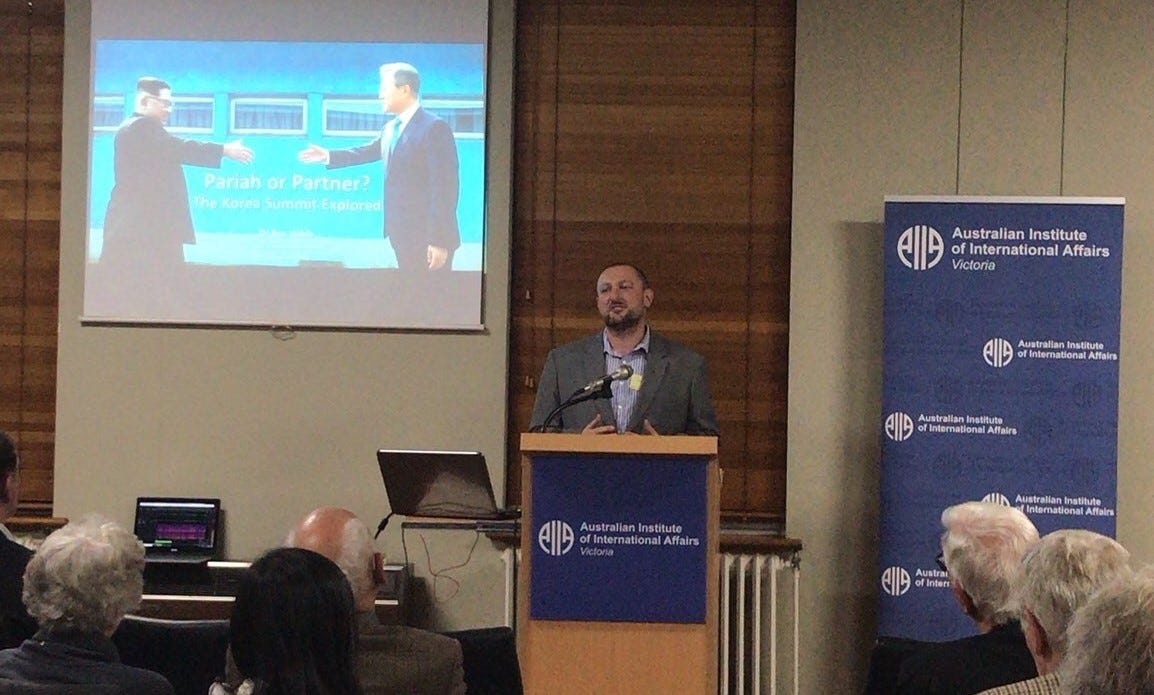
The seminar begins and the panellists deliver their remarks. I remember when I was that person, an invited speaker at equivalent events at the AIIA in Melbourne, delivering presentations on US-North Korea summits and climate security in Northeast Asia. It seems so long ago now. That guy, that version of me, is another person entirely.
I watch with thinly veiled amusement as audience members engage with the panellists during the Q&A portion of the seminar. Some things never change, people still can’t ask a question in a single sentence when a microphone is placed in front of them.
As the Q&A winds up, my former PhD supervisor sits next to me to chat. I tell her about my burnout, about quitting my old job in Melbourne, and what I’m doing now. We agree about the shambles that the Australian university sector has become. This view is so widespread and uncontroversial in the profession that it’s cliché.
These are difficult conversations to have with former colleagues who are still invested in the university system. My resignation represents an implicit rejection of their career identity. I’m the mirror reflecting at them the absurdity of their professional commitment to institutions that drive them into the dirt. Every conversation like this one confirms that I made the right choice to leave.
I feel uneasy as I drive home from the event. At a red light on Pulteney Street I look down at the black stain on my polo shirt, unsure if it’s an omen of networking disaster or a barely noticed quirky garnish on my unreconstructed professional façade. Does it confirm that I can never re-enter academic International Relations spaces as a peer, only as a defector or an imposter? Was this ever the right environment for me?
I still love International Relations and have a passion for the field, but I’m not sure what I’m showing up as now. I feel as anonymous in the profession now as I was as the undergrad drinking at the pub around the corner. For the time being, that’s OK.
AI disclosure statement: Gemini image generator was used to create the thumbnail image for this article.

